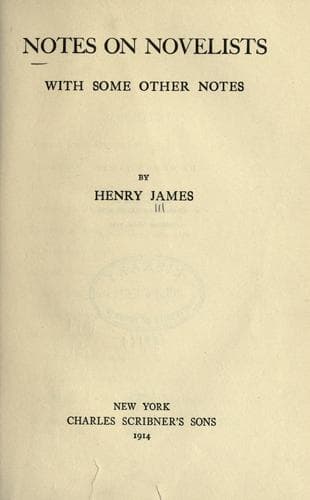
Notes on Novelists, with Some Other NotesJames, Henry
History
Notes on Novelists, with Some Other Notes
James, Henry
Fiction -- History and criticism; Novelists
He found after an extraordinarily adventurous quest the treasure island,
the climatic paradise that met, that enhanced his possibilities; and
with this discovery was ushered in his completely full and rich period,
the time in which—as the wondrous whimsicality and spontaneity of his
correspondence testify—his genius and his character most overflowed. He
had done as well for himself in his appropriation of Samoa as if he had
done it for the hero of a novel, only with the complications and
braveries actual and palpable. “I have no more hope in anything”—and
this in the midst of magnificent production—“than a dead frog; I go
into everything with a composed despair, and don’t mind—just as I
always go to sea with the conviction I am to be drowned, and like it
before all other pleasures.” He could go to sea as often as he liked and
not be spared such hours as one of these pages vividly evokes—those of
the joy of fictive composition in an otherwise prostrating storm, amid
the crash of the elements and with his grasp of his subject but too
needfully sacrificed, it might have appeared, to his clutch of seat and
ink-stand. “If only I could secure a violent death, what a fine success!
I wish to die in my boots; no more Land of Counterpane for me. To be
drowned, to be shot, to be thrown from a horse—aye, to be hanged rather
than pass again through that slow dissolution.”
He speaks in one of the “Vailima Letters,” Mr. Colvin’s publication of
1895, to which it is an office of these volumes promptly to make us
return, of one of his fictions as a “long tough yarn with some pictures
of the manners of to-day in the greater world—not the shoddy sham world
of cities, clubs and colleges, but the world where men still live a
man’s life.” That is distinct, and in the same letter he throws off a
summary of all that in his final phase satisfied and bribed him which is
as significant as it is racy. His correspondent, as was inevitable now
and then for his friends at home, appears to have indulged in one of
those harmless pointings of the moral—as to the distant dangers he
_would_ court—by which we all were more or less moved to relieve
ourselves of the depressed consciousness that he could do beautifully
without us and that our collective tameness was far (which indeed was
distinctly the case) from forming his proper element. There is no
romantic life for which something amiable has not to be sweepingly
sacrificed, and of _us_ in our inevitable category the sweep practically
was clean.
Public-domain text, read in full here on John Shaqi.
Reviews
Reviews
No reviews yet
Be the first to share your thoughts on this work.
Join the Discussion
Join the discussion
Sign in to leave a comment or review.
Sign InorCreate an account