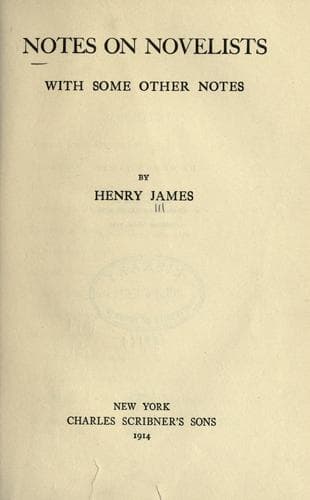
Notes on Novelists, with Some Other NotesJames, Henry
History
Notes on Novelists, with Some Other Notes
James, Henry
Fiction -- History and criticism; Novelists
cloth—if we mean by his cloth his predetermined tone, while in the
other he had to take it already cut. Singular enough in his life the
situation so constituted: the comparatively meagre human
consciousness—for we must come back to that in him—struggling with the
absolutely large artistic; and the large artistic half wreaking itself
on the meagre human and half seeking a refuge from it, as well as a
revenge against it, in something quite different.
Flaubert had in fact command of two refuges which he worked in turn. The
first of these was the attitude of irony, so constant in him that
“L’Éducation” bristles and hardens with it and “Bouvard et
Pécuchet”—strangest of “poetic” justices—is made as dry as sand and as
heavy as lead; the second only was, by processes, by journeys the most
expensive, to get away altogether. And we inevitably ask ourselves
whether, eschewing the policy of flight, he might not after all have
fought out his case a little more on the spot. Might he not have
addressed himself to the human still otherwise than in “L’Éducation” and
in “Bouvard”? When one thinks of the view of the life of his country, of
the vast French community and its constituent creatures, offered in
these productions, one declines to believe it could make up the _whole_
vision of a man of his quality. Or when all was said and done was he
absolutely and exclusively condemned to irony? The second refuge I speak
of, the getting away from the human, the congruously and measurably
human, altogether, perhaps becomes in the light of this possibility but
an irony the more. Carthage and the Thebaid, Salammbô, Spendius, Matho,
Hannon, Saint Anthony, Hilarion, the Paternians, the Marcosians and the
Carpocratians, what are all these, inviting because queer, but a
confession of supreme impatience with the actual and the near, often
queer enough too, no doubt, but not consolingly, not transcendently?
Last remains the question whether, even if our author’s immediate as
distinguished from his remote view had had more reach, the particular
gift we claim for him, the perfection of arrangement and form, would
have had in certain directions the acquired flexibility. States of mind,
states of soul, of the simpler kind, the kinds supposable in the Emma
Bovarys, the Frédérics, the Bouvards and the Pécuchets, to say nothing
of the Carthaginians and the Eremites—for Flaubert’s eremites are
eminently artless—these conditions represent, I think, his proved
psychological range. And that throws us back remarkably, almost
confoundingly, upon another face of the general anomaly. The “gift” was
of the greatest, a force in itself, in virtue of which he is a
consummate writer; and yet there are whole sides of life to which it was
never addressed and which it apparently quite failed to suspect as a
field of exercise. If he never approached the complicated character in
man or woman—Emma Bovary is not the least little bit complicated—or
Public-domain text, read in full here on John Shaqi.
Reviews
Reviews
No reviews yet
Be the first to share your thoughts on this work.
Elsewhere in the archive
Join the Discussion
Join the discussion
Sign in to leave a comment or review.
Sign InorCreate an account