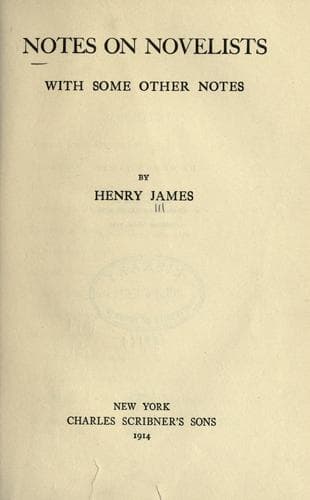
Notes on Novelists, with Some Other NotesJames, Henry
History
Notes on Novelists, with Some Other Notes
James, Henry
Fiction -- History and criticism; Novelists
the really furnished, the finely civilised, was this because,
surprisingly, he could not? _L’âme française_ at all events shows in him
but ill.
This undoubtedly marks a limit, but limits are for the critic familiar
country, and he may mostly well feel the prospect wide enough when he
finds something positively well enough done. By disposition or by
obligation Flaubert selected, and though his selection was in some
respects narrow he stops not too short to have left us three really
“cast” works and a fourth of several perfect parts, to say nothing of
the element of perfection, of the superlative for the size, in his three
_nouvelles_. What he attempted he attempted in a spirit that gives an
extension to the idea of the achievable and the achieved in a literary
thing, and it is by this that we contentedly gauge the matter. As
success goes in this world of the approximate it may pass for success of
the greatest. If I am unable to pursue the proof of my remark in
“Salammbô” and “Saint-Antoine” it is because I have also had to select
and have found the questions connected with their two companions more
interesting. There are numerous judges, I hasten to mention, who,
showing the opposite preference, lose themselves with rapture in the
strange bristling archæological picture—yet all amazingly vivified and
co-ordinated—of the Carthaginian mercenaries in revolt and the sacred
veil of the great goddess profaned and stolen; as well in the still more
peopled panorama of the ancient sects, superstitions and mythologies
that swim in the desert before the fevered eyes of the Saint. One may be
able, however, at once to breathe more freely in “Bovary” than in
“Salammbô” and yet to hope that there is no intention of the latter that
one has missed. The great intention certainly, and little as we may be
sweetly beguiled, holds us fast; which is simply the author’s
indomitable purpose of fully pervading his field. There are countries
beyond the sea in which tracts are allowed to settlers on condition that
they will really, not nominally, cultivate them. Flaubert is on his
romantic ground like one of these settlers; he makes good with all his
might his title to his tract, and in a way that shows how it is not only
for him a question of safety but a question of honour. Honour demands
that he shall set up his home and his faith there in such a way that
every inch of the surface be planted or paved. He would have been
ashamed merely to encamp and, after the fashion of most other
adventurers, knock up a log hut among charred stumps. This was not what
would have been for him taking artistic possession, it was not what
would have been for him even personal honour, let alone literary; and
yet the general lapse from integrity was a thing that, wherever he
looked, he saw not only condoned but acclaimed and rewarded. He lived,
as he felt, in an age of mean production and cheap criticism, the
practical upshot of which took on for him a name that was often on his
lips.
Public-domain text, read in full here on John Shaqi.
Reviews
Reviews
No reviews yet
Be the first to share your thoughts on this work.
Elsewhere in the archive
Join the Discussion
Join the discussion
Sign in to leave a comment or review.
Sign InorCreate an account