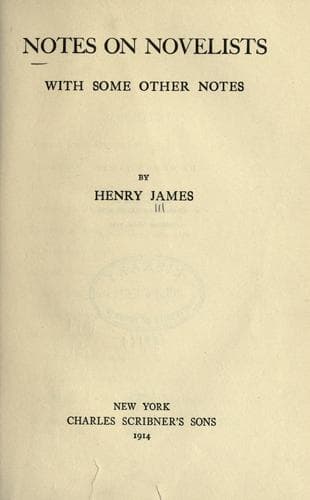
Notes on Novelists, with Some Other NotesJames, Henry
History
Notes on Novelists, with Some Other Notes
James, Henry
Fiction -- History and criticism; Novelists
He called it the hatred of literature, a hatred in the midst of
which, the most literary of men, he found himself appointed to suffer. I
may not, however, follow him in that direction—which would take us far;
and the less that he was for himself after all, in spite of groans and
imprecations, a man of resources and remedies, and that there was always
his possibility of building himself in.
This he did equally in all his books—built himself into literature by
means of a material put together with extraordinary art; but it leads me
again to the question of what such a stiff ideal imposed on him for the
element of exactitude. This element, in the romantic, was his merciless
law; it was perhaps even in the romantic that—if there could indeed be
degrees for him in such matters—he most despised the loose and the
more-or-less. To be intensely definite and perfectly positive, to know
so well what he meant that he could at every point strikingly and
conclusively verify it, was the first of his needs; and if in addition
to being thus synthetically final he could be strange and sad and
terrible, and leave the cause of these effects inscrutable, success then
had for him its highest savour. We feel the inscrutability in those
memorable few words that put before us Frédéric Moreau’s start upon his
vain course of travel, “Il connût alors la mélancholie des paquebots;”
an image to the last degree comprehensive and embracing, but which
haunts us, in its droll pathos, without our quite knowing why. But he
was really never so pleased as when he could be both rare and precise
about the dreadful. His own sense of all this, as I have already
indicated, was that beauty comes with expression, that expression is
creation, that it _makes_ the reality, and only in the degree in which
it _is_, exquisitely, expression; and that we move in literature through
a world of different values and relations, a blest world in which we
know nothing except by style, but in which also everything is saved by
it, and in which the image is thus always superior to the thing itself.
This quest and multiplication of the image, the image tested and
warranted and consecrated for the occasion, was accordingly his high
elegance, to which he too much sacrificed and to which “Salammbô” and
partly “Saint-Antoine” are monstrous monuments. Old cruelties and
perversities, old wonders and errors and terrors, endlessly appealed to
him; they constitute the unhuman side of his work, and if we have not
the bribe of curiosity, of a lively interest in method, or rather in
evocation just _as_ evocation, we tread our way among them, especially
in “Salammbô,” with a reserve too dry for our pleasure. To my own view
the curiosity and the literary interest are equal in dealing with the
non-romantic books, and the world presented, the aspects and agents, are
less deterrent and more amenable both to our own social and expressional
terms. Style itself moreover, with all respect to Flaubert, never
Public-domain text, read in full here on John Shaqi.
Reviews
Reviews
No reviews yet
Be the first to share your thoughts on this work.
Elsewhere in the archive
Join the Discussion
Join the discussion
Sign in to leave a comment or review.
Sign InorCreate an account