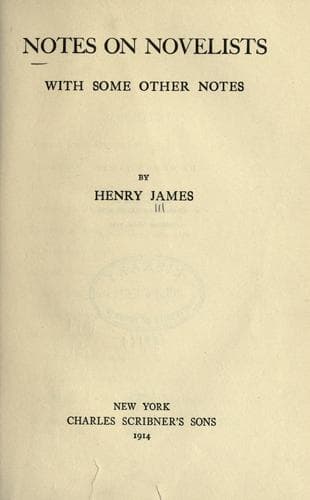
Notes on Novelists, with Some Other NotesJames, Henry
History
Notes on Novelists, with Some Other Notes
James, Henry
Fiction -- History and criticism; Novelists
_totally_ beguiles; since even when we are so queerly constituted as to
be ninety-nine parts literary we are still a hundredth part something
else. This hundredth part may, once we possess the book—or the book
possesses us—make us imperfect as readers, and yet without it should we
want or get the book at all? The curiosity at any rate, to repeat, is
even greatest for me in “Madame Bovary,” say, for here I can measure,
can more directly appreciate, the terms. The aspects and impressions
being of an experience conceivable to me I am more touched by the
beauty; my interest gets more of the benefit of the beauty even though
this be not intrinsically greater. Which brings back our appreciation
inevitably at last to the question of our author’s lucidity.
I have sufficiently remarked that I speak from the point of view of his
interest to a reader of his own craft, the point of view of his
extraordinary technical wealth—though indeed when I think of the
general power of “Madame Bovary” I find myself desiring not to narrow
the ground of the lesson, not to connect the lesson, to its prejudice,
with that idea of the “technical,” that question of the way a thing is
done, so abhorrent, as a call upon attention, in whatever art, to the
wondrous Anglo-Saxon mind. Without proposing Flaubert as the type of the
newspaper novelist, or as an easy alternative to golf or the bicycle, we
should do him less than justice in failing to insist that a masterpiece
like “Madame Bovary” may benefit even with the simple-minded by the way
it has been done. It derives from its firm roundness that sign of all
rare works that there is something in it for every one. It may be read
ever so attentively, ever so freely, without a suspicion of how it is
written, to say nothing of put together; it may equally be read under
the excitement of these perceptions alone, one of the greatest known to
the reader who is fully open to them. Both readers will have been
transported, which is all any can ask. Leaving the first of them,
however that may be, to state the case for himself, I state it yet again
for the second, if only on this final ground. The book and its
companions represent for us a practical solution, Flaubert’s own
troubled but settled one, of the eternal dilemma of the painter of life.
From the moment this rash adventurer deals with his mysterious matter at
all directly his desire is not to deal with it stintedly. It at the same
time remains true that from the moment he desires to produce forms in
which it shall be preserved, he desires that these forms, things of
_his_ creation, shall not be, as testifying to his way with them, weak
or ignoble. He must make them complete and beautiful, of satisfactory
production, intrinsically interesting, under peril of disgrace with
those who know. Those who don’t know of course don’t count for him, and
it neither helps nor hinders him to say that every one knows about life.
Public-domain text, read in full here on John Shaqi.
Reviews
Reviews
No reviews yet
Be the first to share your thoughts on this work.
Elsewhere in the archive
Join the Discussion
Join the discussion
Sign in to leave a comment or review.
Sign InorCreate an account