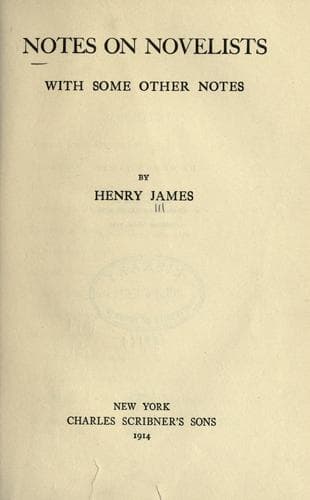
Notes on Novelists, with Some Other NotesJames, Henry
History
Notes on Novelists, with Some Other Notes
James, Henry
Fiction -- History and criticism; Novelists
Every one does not—it is distinctly the case of the few; and if it were
in fact the case of the many the knowledge still might exist, on the
evidence around us, even in an age of unprecedented printing, without
attesting itself by a multiplication of masterpieces. The question for
the artist can only be of doing the artistic utmost, and thereby of
_seeing_ the general task. When it is seen with the intensity with which
it presented itself to Flaubert a lifetime is none too much for fairly
tackling it. It must either be left alone or be dealt with, and to leave
it alone is a comparatively simple matter.
To deal with it is on the other hand to produce a certain number of
finished works; there being no other known method; and the quantity of
life depicted will depend on this array. What will this array, however,
depend on, and what will condition the number of pieces of which it is
composed? The “finish,” evidently, that the formula so glibly postulates
and for which the novelist is thus so handsomely responsible. He has on
the one side to feel his subject and on the other side to render it, and
there are undoubtedly two ways in which his situation may be expressed,
especially perhaps by himself. The more he feels his subject the more he
_can_ render it—that is the first way. The more he renders it the more
he _can_ feel it—that is the second way. This second way was
unmistakeably Flaubert’s, and if the result of it for him was a bar to
abundant production he could only accept such an incident as part of the
game. He probably for that matter would have challenged any easy
definition of “abundance,” contested the application of it to the
repetition, however frequent, of the thing not “done.” What but the
“doing” makes the thing, he would have asked, and how can a positive
result from a mere iteration of negatives, or wealth proceed from the
simple addition of so many instances of penury? We should here, in
closer communion with him, have got into his highly characteristic and
suggestive view of the fertilisation of subject by form, penetration of
the sense, ever, by the expression—the latter reacting creatively on
the former; a conviction in the light of which he appears to have
wrought with real consistency and which borrows from him thus its high
measure of credit. It would undoubtedly have suffered if his books had
been things of a loose logic, whereas we refer to it not only without
shame but with an encouraged confidence by their showing of a logic so
close. Let the phrase, the form that the whole is at the given moment
staked on, be beautiful and related, and the rest will take care of
itself—such is a rough indication of Flaubert’s faith; which has the
importance that it was a faith sincere, active and inspiring. I hasten
to add indeed that we must most of all remember how in these matters
everything hangs on definitions. The “beautiful,” with our author,
covered for the phrase a great deal of ground, and when every sort of
Public-domain text, read in full here on John Shaqi.
Reviews
Reviews
No reviews yet
Be the first to share your thoughts on this work.
Elsewhere in the archive
Join the Discussion
Join the discussion
Sign in to leave a comment or review.
Sign InorCreate an account