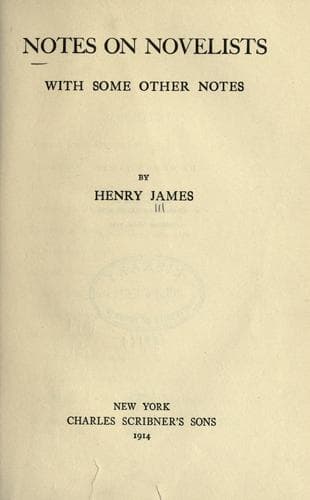
Notes on Novelists, with Some Other NotesJames, Henry
History
Notes on Novelists, with Some Other Notes
James, Henry
Fiction -- History and criticism; Novelists
propriety had been gathered in under it and every relation, in a
complexity of such, protected, the idea itself, the presiding thought,
ended surely by being pretty well provided for.
These, however, are subordinate notes, and the plain question, in the
connection I have touched upon, is of whether we would really wish him
to have written more books, say either of the type of “Bovary” or of the
type of “Salammbô,” and not have written them so well. When the
production of a great artist who has lived a length of years has been
small there is always the regret; but there is seldom, any more than
here, the conceivable remedy. For the case is doubtless predetermined by
the particular kind of great artist a writer happens to be, and this
even if when we come to the conflict, to the historic case, deliberation
and delay may not all have been imposed by temperament. The admirable
George Sand, Flaubert’s beneficent friend and correspondent, is exactly
the happiest example we could find of the genius constitutionally
incapable of worry, the genius for whom style “came,” for whom the
sought effect was ever quickly and easily struck off, the book freely
and swiftly written, and who consequently is represented for us by
upwards of ninety volumes. If the comparison were with this lady’s great
contemporary the elder Dumas the disparity would be quadrupled, but that
ambiguous genius, somehow never really caught by us in the _fact_ of
composition, is out of our concern here: the issue is of those
developments of expression which involve a style, and as Dumas never so
much as once grazed one in all his long career, there was not even
enough of that grace in him for a fillip of the finger-nail. Flaubert is
at any rate represented by six books, so that he may on that estimate
figure as poor, while Madame Sand, falling so little short of a hundred,
figures as rich; and yet the fact remains that I can refer the congenial
mind to him with confidence and can do nothing of the sort for it in
respect to Madame Sand. She is loose and liquid and iridescent, as
iridescent as we may undertake to find her; but I can imagine
compositions quite without virtue—the virtue I mean, of sticking
together—begotten by the impulse to emulate her. She had undoubtedly
herself the benefit of her facility, but are we not left wondering to
what extent _we_ have it? There is too little in her, by the literary
connection, for the critical mind, weary of much wandering, to rest
upon. Flaubert himself wandered, wandered far, went much roundabout and
sometimes lost himself by the way, but how handsomely he provided for
our present repose! He found the French language inconceivably difficult
to write with elegance and was confronted with the equal truths that
elegance is the last thing that languages, even as they most mature,
seem to concern themselves with, and that at the same time taste,
asserting rights, insists on it, to the effect of showing us in a
Public-domain text, read in full here on John Shaqi.
Reviews
Reviews
No reviews yet
Be the first to share your thoughts on this work.
Elsewhere in the archive
Join the Discussion
Join the discussion
Sign in to leave a comment or review.
Sign InorCreate an account