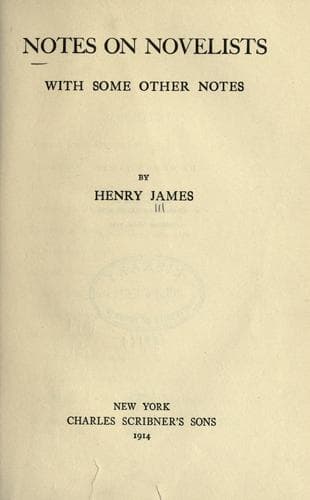
Notes on Novelists, with Some Other NotesJames, Henry
History
Notes on Novelists, with Some Other Notes
James, Henry
Fiction -- History and criticism; Novelists
boundless circumjacent waste of effort what the absence of it may mean.
He saw the less of this desert of death come back to that—that
everything at all saved from it for us since the beginning had been
saved by a soul of elegance within, or in other words by the last
refinement of selection, by the indifference on the part of the very
idiom, huge quite other than “composing” agent, to the individual
pretension. Recognising thus that to carry through the individual
pretension is at the best a battle, he adored a hard surface and
detested a soft one—much more a muddled; regarded a style without
rhythm and harmony as in a work of pretended beauty no style at all. He
considered that the failure of complete expression so registered made of
the work of pretended beauty a work of achieved barbarity. It would take
us far to glance even at his fewest discriminations; but rhythm and
harmony were for example most menaced in his scheme by repetition—when
repetition had not a positive grace; and were above all most at the
mercy of the bristling particles of which our modern tongues are mainly
composed and which make of the desired surface a texture pricked
through, from beneath, even to destruction, as by innumerable thorns.
On these lines production was of course slow work for him—especially as
he met the difficulty, met it with an inveteracy which shows how it
_can_ be met; and full of interest for readers of English speech is the
reflection he causes us to make as to the possibility of success at all
comparable among ourselves. I have spoken of his groans and
imprecations, his interminable waits and deep despairs; but what would
these things have been, what would have become of him and what of his
wrought residuum, had he been condemned to deal with a form of speech
consisting, like ours, as to one part, of “that” and “which”; as to a
second part, of the blest “it,” which an English sentence may repeat in
three or four opposed references without in the least losing caste; as
to a third face of all the “tos” of the infinitive and the preposition;
as to a fourth of our precious auxiliaries “be” and “do”; and as to a
fifth, of whatever survives in the language for the precious art of
pleasing? Whether or no the fact that the painter of “life” among us has
to contend with a medium intrinsically indocile, on certain sides, like
our own, whether this drawback accounts for his having failed, in our
time, to treat us, arrested and charmed, to a single case of crowned
classicism, there is at any rate no doubt that we in some degree owe
Flaubert’s counter-weight for that deficiency to _his_ having, on his
own ground, more happily triumphed. By which I do not mean that “Madame
Bovary” is a classic because the “thats,” the “its” and the “tos” are
made to march as Orpheus and his lute made the beasts, but because the
element of order and harmony works as a symbol of everything else that
is preserved for us by the history of the book. The history of the book
Public-domain text, read in full here on John Shaqi.
Reviews
Reviews
No reviews yet
Be the first to share your thoughts on this work.
Elsewhere in the archive
Join the Discussion
Join the discussion
Sign in to leave a comment or review.
Sign InorCreate an account