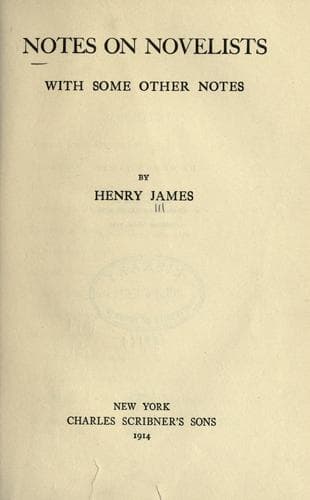
Notes on Novelists, with Some Other NotesJames, Henry
History
Notes on Novelists, with Some Other Notes
James, Henry
Fiction -- History and criticism; Novelists
remains the lesson and the important, the delightful thing, remains
above all the drama that moves slowly to its climax. It is what we come
back to for the sake of what it shows us. We see—from the present to
the past indeed, never alas from the present to the future—how a
classic almost inveterately grows. Unimportant, unnoticed, or, so far as
noticed, contested, unrelated, alien, it has a cradle round which the
fairies but scantly flock and is waited on in general by scarce a hint
of significance. The significance comes by a process slow and small, the
fact only that one perceptive private reader after another discovers at
his convenience that the book is rare. The addition of the perceptive
private readers is no quick affair, and would doubtless be a vain one
did they not—while plenty of other much more remarkable books come and
go—accumulate and count. They count by their quality and continuity of
attention; so they have gathered for “Madame Bovary,” and so they are
held. That is really once more the great circumstance. It is always in
order for us to feel yet again what it is we are held by. Such is my
reason, definitely, for speaking of Flaubert as the novelist’s novelist.
Are we not moreover—and let it pass this time as a happy hope!—pretty
well all novelists now?
-----
Footnote 2:
On the occasion of these prefatory remarks to a translation of “Madame
Bovary,” appearing in A Century of French Romance, under the auspices of
Mr. Edmund Gosse and Mr. William Heinemann, in 1902.
Footnote 3:
It was true, delightfully true, that, extravagance in this province of
his life, though apparently in no other, being Flaubert’s necessity and
law, he deliberated and hung fire, wrestled, retreated and returned,
indulged generally in a tragi-comedy of waste; which I recall a charming
expression of on the lips of Edmond de Goncourt, who quite recognised
the heroic legend, but prettily qualified it: “Il faut vous dire qu’il y
avait là-dedans beaucoup de coucheries et d’école buissonière.” And he
related how on the occasion of a stay with his friend under the roof of
the Princess Mathilde, the friend, missed during the middle hours of a
fine afternoon, was found to have undressed himself and gone to bed to
think!
HONORÉ DE BALZAC
1902
I
Public-domain text, read in full here on John Shaqi.
Reviews
Reviews
No reviews yet
Be the first to share your thoughts on this work.
Elsewhere in the archive
Join the Discussion
Join the discussion
Sign in to leave a comment or review.
Sign InorCreate an account