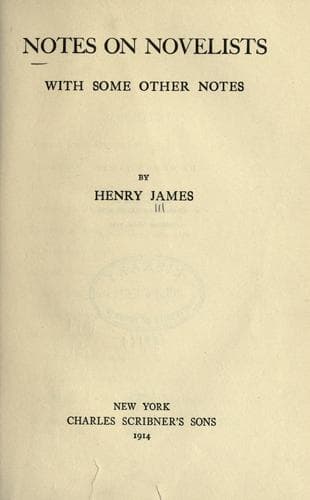
Notes on Novelists, with Some Other NotesJames, Henry
History
Notes on Novelists, with Some Other Notes
James, Henry
Fiction -- History and criticism; Novelists
Stronger than ever, even than under the spell of first acquaintance and
of the early time, is the sense—thanks to a renewal of intimacy and, I
am tempted to say, of loyalty—that Balzac stands signally apart, that
he is the first and foremost member of his craft, and that above all the
Balzac-lover is in no position till he has cleared the ground by saying
so. The Balzac-lover alone, for that matter, is worthy to have his word
on so happy an occasion as this[4] about the author of “La Comédie
Humaine,” and it is indeed not easy to see how the amount of attention
so inevitably induced could at the worst have failed to find itself
turning to an act of homage. I have been deeply affected, to be frank,
by the mere refreshment of memory, which has brought in its train
moreover consequences critical and sentimental too numerous to figure
here in their completeness. The authors and the books that have, as we
say, done something for us, become part of the answer to our curiosity
when our curiosity had the freshness of youth, these particular agents
exist for us, with the lapse of time, as the substance itself of
knowledge: they have been intellectually so swallowed, digested and
assimilated that we take their general use and suggestion for granted,
cease to be aware of them because they have passed out of sight. But
they have passed out of sight simply by having passed into our lives.
They have become a part of our personal history, a part of ourselves,
very often, so far as we may have succeeded in best expressing
ourselves. Endless, however, are the uses of great persons and great
things, and it may easily happen in these cases that the connection,
even as an “excitement”—the form mainly of the connections of youth—is
never really broken. We have largely been living on our
benefactor—which is the highest acknowledgment one can make; only,
thanks to a blest law that operates in the long run to rekindle
excitement, we are accessible to the sense of having neglected him. Even
when we may not constantly have read him over the neglect is quite an
illusion, but the illusion perhaps prepares us for the finest emotion we
are to have owed to the acquaintance. Without having abandoned or denied
our author we yet come expressly back to him, and if not quite in
tatters and in penitence like the Prodigal Son, with something at all
events of the tenderness with which we revert to the parental threshold
and hearthstone, if not, more fortunately, to the parental presence. The
beauty of this adventure, that of seeing the dust blown off a relation
that had been put away as on a shelf, almost out of reach, at the back
of one’s mind, consists in finding the precious object not only fresh
and intact, but with its firm lacquer still further figured, gilded and
enriched. It is all overscored with traces and impressions—vivid,
definite, almost as valuable as itself—of the recognitions and
agitations it originally produced in us. Our old—that is our
Public-domain text, read in full here on John Shaqi.
Reviews
Reviews
No reviews yet
Be the first to share your thoughts on this work.
Elsewhere in the archive
Join the Discussion
Join the discussion
Sign in to leave a comment or review.
Sign InorCreate an account