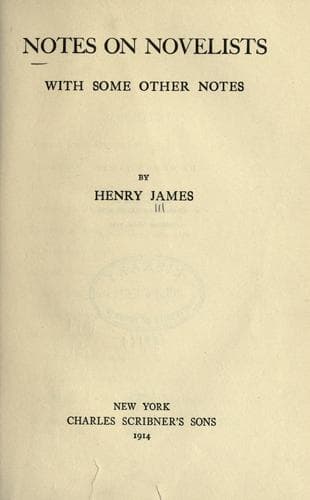
Notes on Novelists, with Some Other NotesJames, Henry
History
Notes on Novelists, with Some Other Notes
James, Henry
Fiction -- History and criticism; Novelists
young—feelings are very nearly what page after page most gives us. The
case has become a case of authority _plus_ association. If Balzac in
himself is indubitably wanting in the sufficiently common felicity we
know as charm, it is this association that may on occasion contribute
the grace.
The impression then, confirmed and brightened, is of the mass and weight
of the figure and of the extent of ground it occupies; a tract on which
we might all of us together quite pitch our little tents, open our
little booths, deal in our little wares, and not materially either
diminish the area or impede the circulation of the occupant. I seem to
see him in such an image moving about as Gulliver among the pigmies, and
not less good-natured than Gulliver for the exercise of any function,
without exception, that can illustrate his larger life. The first and
the last word about the author of “Les Contes Drolatiques” is that of
all novelists he is the most serious—by which I am far from meaning
that in the human comedy as he shows it the comic is an absent quantity.
His sense of the comic was on the scale of his extraordinary senses in
general, though his expression of it suffers perhaps exceptionally from
that odd want of elbow-room—the penalty somehow of his close-packed,
pressed-down contents—which reminds us of some designedly beautiful
thing but half-disengaged from the clay or the marble. It is the scheme
and the scope that are supreme in him, applying this moreover not to
mere great intention, but to the concrete form, the proved case, in
which we possess them. We most of us aspire to achieve at the best but a
patch here and there, to pluck a sprig or a single branch, to break
ground in a corner of the great garden of life. Balzac’s plan was simply
to do everything that could be done. He proposed to himself to “turn
over” the great garden from north to south and from east to west; a
task—immense, heroic, to this day immeasurable—that he bequeathed us
the partial performance of, a prodigious ragged clod, in the twenty
monstrous years representing his productive career, years of
concentration and sacrifice the vision of which still makes us ache. He
had indeed a striking good fortune, the only one he was to enjoy as an
harassed and exasperated worker: the great garden of life presented
itself to him absolutely and exactly in the guise of the great garden of
France, a subject vast and comprehensive enough, yet with definite edges
and corners. This identity of his universal with his local and national
vision is the particular thing we should doubtless call his greatest
strength were we preparing agreeably to speak of it also as his visible
weakness. Of Balzac’s weaknesses, however, it takes some assurance to
talk; there is always plenty of time for them; they are the last signs
we know him by—such things truly as in other painters of manners often
come under the head of mere exuberance of energy. So little in short do
Public-domain text, read in full here on John Shaqi.
Reviews
Reviews
No reviews yet
Be the first to share your thoughts on this work.
Elsewhere in the archive
Join the Discussion
Join the discussion
Sign in to leave a comment or review.
Sign InorCreate an account