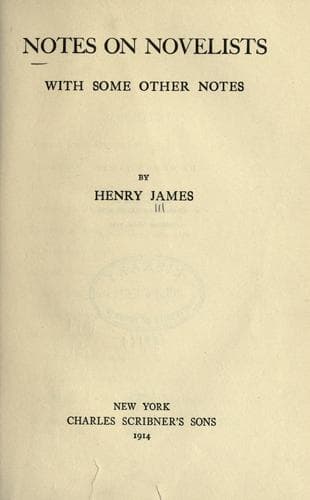
Notes on Novelists, with Some Other NotesJames, Henry
History
Notes on Novelists, with Some Other Notes
James, Henry
Fiction -- History and criticism; Novelists
they earn the invidious name even when we feel them as defects.
What he did above all was to read the universe, as hard and as loud as
he could, _into_ the France of his time; his own eyes regarding his work
as at once the drama of man and a mirror of the mass of social phenomena
the most rounded and registered, most organised and administered, and
thereby most exposed to systematic observation and portrayal, that the
world had seen. There are happily other interesting societies, but these
are for schemes of such an order comparatively loose and incoherent,
with more extent and perhaps more variety, but with less of the great
enclosed and exhibited quality, less neatness and sharpness of
arrangement, fewer categories, sub-divisions, juxtapositions. Balzac’s
France was both inspiring enough for an immense prose epic and reducible
enough for a report or a chart. To allow his achievement all its dignity
we should doubtless say also treatable enough for a history, since it
was as a patient historian, a Benedictine of the actual, the living
painter of his living time, that he regarded himself and handled his
material. All painters of manners and fashions, if we will, are
historians, even when they least don the uniform: Fielding, Dickens,
Thackeray, George Eliot, Hawthorne among ourselves. But the great
difference between the great Frenchman and the eminent others is that,
with an imagination of the highest power, an unequalled intensity of
vision, he saw his subject in the light of science as well, in the light
of the bearing of all its parts on each other, and under pressure of a
passion for exactitude, an appetite, the appetite of an ogre, for _all_
the kinds of facts. We find I think in the union here suggested
something like the truth about his genius, the nearest approach to a
final account of him. Of imagination on one side all compact, he was on
the other an insatiable reporter of the immediate, the material, the
current combination, and perpetually moved by the historian’s impulse to
fix, preserve and explain them. One asks one’s self as one reads him
what concern the poet has with so much arithmetic and so much criticism,
so many statistics and documents, what concern the critic and the
economist have with so many passions, characters and adventures. The
contradiction is always before us; it springs from the inordinate scale
of the author’s two faces; it explains more than anything else his
eccentricities and difficulties. It accounts for his want of grace, his
want of the lightness associated with an amusing literary form, his
bristling surface, his closeness of texture, so rough with richness, yet
so productive of the effect we have in mind when we speak of not being
able to see the wood for the trees.
Public-domain text, read in full here on John Shaqi.
Reviews
Reviews
No reviews yet
Be the first to share your thoughts on this work.
Elsewhere in the archive
Join the Discussion
Join the discussion
Sign in to leave a comment or review.
Sign InorCreate an account