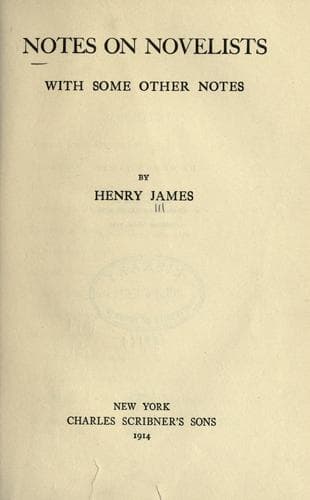
Notes on Novelists, with Some Other NotesJames, Henry
History
Notes on Novelists, with Some Other Notes
James, Henry
Fiction -- History and criticism; Novelists
A thorough-paced votary, for that matter, can easily afford to declare
at once that this confounding duality of character does more things
still, or does at least the most important of all—introduces us without
mercy (mercy for ourselves I mean) to the oddest truth we could have
dreamed of meeting in such a connection. It was certainly _a priori_ not
to be expected we should feel it of him, but our hero is after all not
in his magnificence totally an artist: which would be the strangest
thing possible, one must hasten to add, were not the smallness of the
practical difference so made even stranger. His endowment and his effect
are each so great that the anomaly makes at the most a difference only
by adding to his interest for the critic. The critic worth his salt is
indiscreetly curious and wants ever to know how and why—whereby Balzac
is thus a still rarer case for him, suggesting that exceptional
curiosity may have exceptional rewards. The question of what makes the
artist on a great scale is interesting enough; but we feel it in
Balzac’s company to be nothing to the question of what on an equal scale
frustrates him. The scattered pieces, the _disjecta membra_ of the
character are here so numerous and so splendid that they prove
misleading; we pile them together, and the heap assuredly is monumental;
it forms an overtopping figure. The genius this figure stands for, none
the less, is really such a lesson to the artist as perfection itself
would be powerless to give; it carries him so much further into the
special mystery. Where it carries him, at the same time, I must not in
this scant space attempt to say—which would be a loss of the fine
thread of my argument. I stick to our point in putting it, more
concisely, that the artist of the Comédie Humaine is half smothered by
the historian. Yet it belongs as well to the matter also to meet the
question of whether the historian himself may not be an artist—in which
case Balzac’s catastrophe would seem to lose its excuse. The answer of
course is that the reporter, however philosophic, has one law, and the
originator, however substantially fed, has another; so that the two laws
can with no sort of harmony or congruity make, for the finer sense, a
common household. Balzac’s catastrophe—so to name it once again—was in
this perpetual conflict and final impossibility, an impossibility that
explains his defeat on the classic side and extends so far at times as
to make us think of his work as, from the point of view of beauty, a
tragic waste of effort.
Public-domain text, read in full here on John Shaqi.
Reviews
Reviews
No reviews yet
Be the first to share your thoughts on this work.
Elsewhere in the archive
Join the Discussion
Join the discussion
Sign in to leave a comment or review.
Sign InorCreate an account