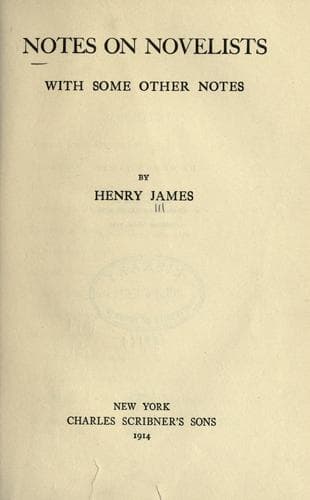
Notes on Novelists, with Some Other NotesJames, Henry
History
Notes on Novelists, with Some Other Notes
James, Henry
Fiction -- History and criticism; Novelists
What it would come to, we judge, is that the irreconcilability of the
two kinds of law is, more simply expressed, but the irreconcilability of
two different ways of composing one’s effect. The principle of
composition that his free imagination would have, or certainly might
have, handsomely imposed on him is perpetually dislocated by the quite
opposite principle of the earnest seeker, the inquirer to a useful end,
in whom nothing is free but a born antipathy to his yoke-fellow. Such a
production as “Le Curé de Village,” the wonderful story of Madame
Graslin, so nearly a masterpiece yet so ultimately not one, would be, in
this connection, could I take due space for it, a perfect illustration.
If, as I say, Madame Graslin’s creator was confined by his doom to
patches and pieces, no piece is finer than the first half of the book in
question, the half in which the picture is determined by his unequalled
power of putting people on their feet, planting them before us in their
habit as they lived—a faculty nourished by observation as much as one
will, but with the inner vision all the while wide-awake, the vision for
which ideas are as living as facts and assume an equal intensity. This
intensity, greatest indeed in the facts, has in Balzac a force all its
own, to which none other in any novelist I know can be likened. His
touch communicates on the spot to the object, the creature evoked, the
hardness and permanence that certain substances, some sorts of stone,
acquire by exposure to the air. The hardening medium, for the image
soaked in it, is the air of his mind. It would take but little more to
make the peopled world of fiction as we know it elsewhere affect us by
contrast as a world of rather gray pulp. This mixture of the solid and
the vivid is Balzac at his best, and it prevails without a break,
without a note not admirably true, in “Le Curé de Village”—since I have
named that instance—up to the point at which Madame Graslin moves out
from Limoges to Montégnac in her ardent passion of penitence, her
determination to expiate her strange and undiscovered association with a
dark misdeed by living and working for others. Her drama is a
particularly inward one, interesting, and in the highest degree, so long
as she herself, her nature, her behaviour, her personal history and the
relations in which they place her, control the picture and feed our
illusion. The firmness with which the author makes them play this part,
the whole constitution of the scene and of its developments from the
moment we cross the threshold of her dusky stuffy old-time birth-house,
is a rare delight, producing in the reader that sense of local and
material immersion which is one of Balzac’s supreme secrets. What
characteristically befalls, however, is that the spell accompanies us
but part of the way—only until, at a given moment, his attention
ruthlessly transfers itself from inside to outside, from the centre of
his subject to its circumference.
Public-domain text, read in full here on John Shaqi.
Reviews
Reviews
No reviews yet
Be the first to share your thoughts on this work.
Elsewhere in the archive
Join the Discussion
Join the discussion
Sign in to leave a comment or review.
Sign InorCreate an account