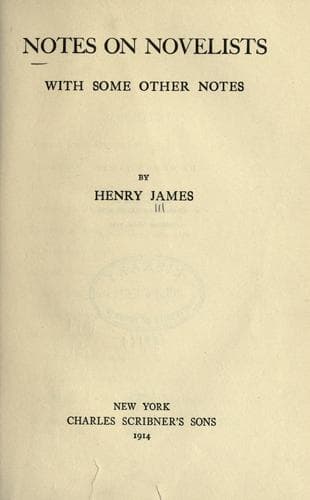
Notes on Novelists, with Some Other NotesJames, Henry
History
Notes on Novelists, with Some Other Notes
James, Henry
Fiction -- History and criticism; Novelists
This is Balzac caught in the very fact of his monstrous duality, caught
in his most complete self-expression. He is clearly quite unwitting that
in handing over his _data_ to his twin-brother the impassioned economist
and surveyor, the insatiate general inquirer and reporter, he is in any
sort betraying our confidence, for his good conscience at such times,
the spirit of edification in him, is a lesson even to the best of us,
his rich robust temperament nowhere more striking, no more marked
anywhere the great push of the shoulder with which he makes his theme
move, overcharged though it may be like a carrier’s van. It is not
therefore assuredly that he loses either sincerity or power in putting
before us to the last detail such a matter as, in this case, his
heroine’s management of her property, her tenantry, her economic
opportunities and visions, for these are cases in which he never shrinks
nor relents, in which positively he stiffens and terribly towers—to
remind us again of M. Taine’s simplifying word about his being an artist
doubled with a man of business. Balzac was indeed doubled if ever a
writer was, and to that extent that we almost as often, while we read,
feel ourselves thinking of him as a man of business doubled with an
artist. Whichever way we turn it the oddity never fails, nor the wonder
of the ease with which either character bears the burden of the other. I
use the word burden because, as the fusion is never complete—witness in
the book before us the fatal break of “tone,” the one unpardonable sin
for the novelist—we are beset by the conviction that but for this
strangest of dooms one or other of the two partners might, to our relief
and to his own, have been disembarrassed. The disembarrassment, for
each, by a more insidious fusion, would probably have conduced to the
mastership of interest proceeding from form, or at all events to the
search for it, that Balzac fails to embody. Perhaps the possibility of
an artist constructed on such strong lines is one of those fine things
that are not of this world, a mere dream of the fond critical spirit.
Let these speculations and condonations at least pass as the amusement,
as a result of the high spirits—if high spirits be the word—of the
reader feeling himself again in touch. It was not of our author’s
difficulties—that is of his difficulty, the great one—that I proposed
to speak, but of his immense clear action. Even that is not truly an
impression of ease, and it is strange and striking that we are in fact
so attached by his want of the unity that keeps surfaces smooth and
dangers down as scarce to feel sure at any moment that we shall not come
back to it with most curiosity. We are never so curious about successes
as about interesting failures. The more reason therefore to speak
promptly, and once for all, of the scale on which, in its own quarter of
his genius, success worked itself out for him.
Public-domain text, read in full here on John Shaqi.
Reviews
Reviews
No reviews yet
Be the first to share your thoughts on this work.
Elsewhere in the archive
Join the Discussion
Join the discussion
Sign in to leave a comment or review.
Sign InorCreate an account