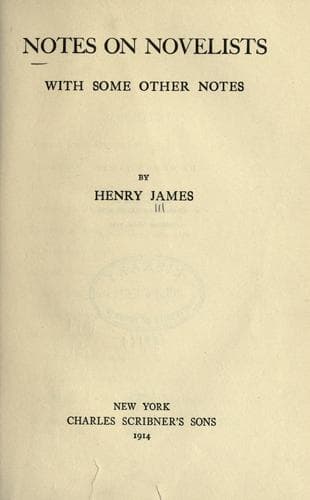
Notes on Novelists, with Some Other NotesJames, Henry
History
Notes on Novelists, with Some Other Notes
James, Henry
Fiction -- History and criticism; Novelists
It is to that I _should_ come back—to the infinite reach in him of the
painter and the poet. We can never know what might have become of him
with less importunity in his consciousness of the machinery of life, of
its furniture and fittings, of all that, right and left, he causes to
assail us, sometimes almost to suffocation, under the general rubric of
_things_. Things, in this sense with him, are at once our delight and
our despair; we pass from being inordinately beguiled and convinced by
them to feeling that his universe fairly smells too much of them, that
the larger ether, the diviner air, is in peril of finding among them
scarce room to circulate. His landscapes, his “local colour”—thick in
his pages at a time when it was to be found in his pages almost
alone—his towns, his streets, his houses, his Saumurs, Angoulêmes,
Guérandes, his great prose Turner-views of the land of the Loire, his
rooms, shops, interiors, details of domesticity and traffic, are a short
list of the terms into which he saw the real as clamouring to be
rendered and into which he rendered it with unequalled authority. It
would be doubtless more to the point to make our profit of this
consummation than to try to reconstruct a Balzac planted more in the
open. We hardly, as the case stands, know most whether to admire in such
an example as the short tale of “La Grenadière” the exquisite feeling
for “natural objects” with which it overflows like a brimming wine-cup,
the energy of perception and description which so multiplies them for
beauty’s sake and for the love of their beauty, or the general wealth of
genius that can calculate, or at least count, so little and spend so
joyously. The tale practically exists for the sake of the enchanting
aspects involved—those of the embowered white house that nestles on its
terraced hill above the great French river, and we can think, frankly,
of no one else with an equal amount of business on his hands who would
either have so put himself out for aspects or made them almost by
themselves a living subject. A born son of Touraine, it must be said, he
pictures his province, on every pretext and occasion, with filial
passion and extraordinary breadth. The prime aspect in his scene all the
while, it must be added, is the money aspect. The general money question
so loads him up and weighs him down that he moves through the human
comedy, from beginning to end, very much in the fashion of a camel, the
ship of the desert, surmounted with a cargo. “Things” for him are francs
and centimes more than any others, and I give up as inscrutable,
unfathomable, the nature, the peculiar avidity of his interest in them.
It makes us wonder again and again what then is the use on Balzac’s
scale of the divine faculty. The imagination, as we all know, may be
employed up to a certain point in inventing uses for money; but its
office beyond that point is surely to make us forget that anything so
odious exists.
Public-domain text, read in full here on John Shaqi.
Reviews
Reviews
No reviews yet
Be the first to share your thoughts on this work.
Elsewhere in the archive
Join the Discussion
Join the discussion
Sign in to leave a comment or review.
Sign InorCreate an account