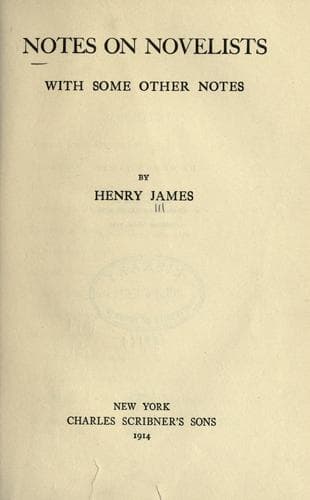
Notes on Novelists, with Some Other NotesJames, Henry
History
Notes on Novelists, with Some Other Notes
James, Henry
Fiction -- History and criticism; Novelists
This is what Balzac never forgot; his universe goes on
expressing itself for him, to its furthest reaches, on its finest sides,
in the terms of the market. To say these things, however, is after all
to come out where we want, to suggest his extraordinary scale and his
terrible completeness. I am not sure that he does not see character too,
see passion, motive, personality, as quite in the order of the “things”
we have spoken of. He makes them no less concrete and palpable, handles
them no less directly and freely. It is the whole business in fine—that
grand total to which he proposed to himself to do high justice—that
gives him his place apart, makes him, among the novelists, the largest
weightiest presence. There are some of his obsessions—that of the
material, that of the financial, that of the “social,” that of the
technical, political, civil—for which I feel myself unable to judge
him, judgment losing itself unexpectedly in a particular shade of pity.
The way to judge him is to try to walk all round him—on which we see
how remarkably far we have to go. He is the only member of his order
really monumental, the sturdiest-seated mass that rises in our path.
-----
Footnote 4:
The appearance of a translation of the “Deux Jeunes Mariées” in A
Century of French Romance.
II
We recognise none the less that the finest consequence of these
re-established relations is linked with just that appearance in him,
that obsession of the actual under so many heads, that makes us look at
him, as we would at some rare animal in captivity, between the bars of a
cage. It amounts to a sort of suffered doom, since to be solicited by
the world from all quarters at once, what is that for the spirit but a
denial of escape? We feel his doom to be his want of a private door, and
that he felt it, though more obscurely, himself. When we speak of his
want of charm therefore we perhaps so surrender the question as but to
show our own poverty. If charm, to cut it short, is what he lacks, how
comes it that he so touches and holds us that—above all if we be actual
or possible fellow-workers—we are uncomfortably conscious of the
disloyalty of almost any shade of surrender? We are lodged perhaps by
our excited sensibility in a dilemma of which one of the horns is a
compassion that savours of patronage; but we must resign ourselves to
that by reflecting that our partiality at least takes nothing away from
him. It leaves him solidly where he is and only brings us near, brings
us to a view of _all_ his formidable parts and properties. The
conception of the Comédie Humaine represents them all, and represents
them mostly in their felicity and their triumph—or at least the
execution does: in spite of which we irresistibly find ourselves
thinking of him, in reperusals, as most essentially the victim of a
cruel joke. The joke is one of the jokes of fate, the fate that rode him
for twenty years at so terrible a pace and with the whip so constantly
Public-domain text, read in full here on John Shaqi.
Reviews
Reviews
No reviews yet
Be the first to share your thoughts on this work.
Elsewhere in the archive
Join the Discussion
Join the discussion
Sign in to leave a comment or review.
Sign InorCreate an account