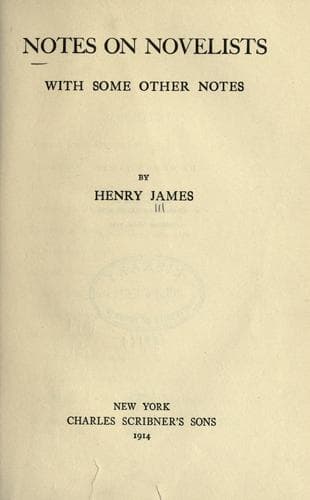
Notes on Novelists, with Some Other NotesJames, Henry
History
Notes on Novelists, with Some Other Notes
James, Henry
Fiction -- History and criticism; Novelists
applied. To have wanted to do so much, to have thought it possible, to
have faced and in a manner resisted the effort, to have felt life
poisoned and consumed by such a bravery of self-committal—these things
form for us in him a face of trouble that, oddly enough, is not
appreciably lighted by the fact of his success. It was the having wanted
to do so much that was the trap, whatever possibilities of glory might
accompany the good faith with which he fell into it. What accompanies
_us_ as we frequent him is a sense of the deepening ache of that good
faith with the increase of his working consciousness, the merciless
development of his huge subject and of the rigour of all the conditions.
We see the whole thing quite as if Destiny had said to him: “You want to
‘do’ France, presumptuous, magnificent, miserable man—the France of
revolutions, revivals, restorations, of Bonapartes, Bourbons, republics,
of war and peace, of blood and romanticism, of violent change and
intimate continuity, the France of the first half of your century? Very
well; you most distinctly _shall_, and you shall particularly let me
hear, even if the great groan of your labour do fill at moments the
temple of letters, how you like the job.” We must of course not appear
to deny the existence of a robust joy in him, the joy of power and
creation, the joy of the observer and the dreamer who finds a use for
his observations and his dreams as fast as they come. The “Contes
Drolatiques” would by themselves sufficiently contradict us, and the
savour of the “Contes Drolatiques” is not confined to these productions.
His work at large tastes of the same kind of humour, and we feel him
again and again, like any other great healthy producer of these matters,
beguiled and carried along. He would have been, I dare say, the last not
to insist that the artist has pleasures forever indescribable; he lived
in short in his human comedy with the largest life we can attribute to
the largest capacity. There are particular parts of his subject from
which, with our sense of his enjoyment of them, we have to check the
impulse to call him away—frequently as I confess in this relation that
impulse arises.
Public-domain text, read in full here on John Shaqi.
Reviews
Reviews
No reviews yet
Be the first to share your thoughts on this work.
Elsewhere in the archive
Join the Discussion
Join the discussion
Sign in to leave a comment or review.
Sign InorCreate an account