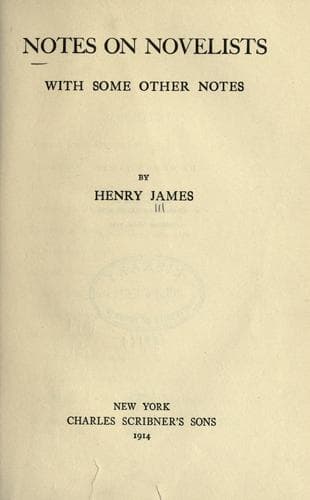
Notes on Novelists, with Some Other NotesJames, Henry
History
Notes on Novelists, with Some Other Notes
James, Henry
Fiction -- History and criticism; Novelists
The relation is with the special element of his spectacle from which he
never fully detaches himself, the element, to express it succinctly, of
the “old families” and the great ladies. Balzac frankly revelled in his
conception of an aristocracy—a conception that never succeeded in
becoming his happiest; whether, objectively, thanks to the facts
supplied him by the society he studied, or through one of the strangest
deviations of taste that the literary critic is in an important
connection likely to encounter. Nothing would in fact be more
interesting than to attempt a general measure of the part played in the
total comedy, to his imagination, by the old families; and one or two
contributions to such an attempt I must not fail presently to make. I
glance at them here, however, the delectable class, but as most
representing on the author’s part free and amused creation; by which too
I am far from hinting that the amusement is at all at their expense. It
is in their great ladies that the old families most shine out for him,
images of strange colour and form, but “felt” as we say, to their
finger-tips, and extraordinarily interesting as a mark of the high
predominance—predominance of character, of cleverness, of will, of
general “personality”—that almost every scene of the Comedy attributes
to women. It attributes to them in fact a recognised, an uncontested
supremacy; it is through them that the hierarchy of old families most
expresses itself; and it is as surrounded by them even as some
magnificent indulgent pasha by his overflowing seraglio that Balzac sits
most at his ease. All of which reaffirms—if it be needed—that his
inspiration, and the sense of it, were even greater than his task. And
yet such betrayals of spontaneity in him make for an old friend at the
end of the chapter no great difference in respect to the pathos—since
it amounts to that—of his genius-ridden aspect. It comes to us as we go
back to him that his spirit had fairly made of itself a cage in which he
was to turn round and round, always unwinding his reel, much in the
manner of a criminal condemned to hard labour for life. The cage is
simply the complicated but dreadfully definite French world that built
itself so solidly in and roofed itself so impenetrably over him.
Public-domain text, read in full here on John Shaqi.
Reviews
Reviews
No reviews yet
Be the first to share your thoughts on this work.
Elsewhere in the archive
Join the Discussion
Join the discussion
Sign in to leave a comment or review.
Sign InorCreate an account