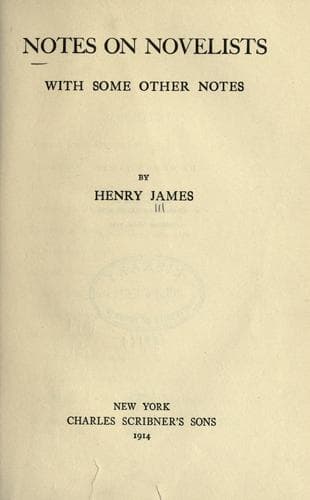
Notes on Novelists, with Some Other NotesJames, Henry
History
Notes on Novelists, with Some Other Notes
James, Henry
Fiction -- History and criticism; Novelists
It is not that, caught there with him though we be, we ourselves
prematurely seek an issue: we throw ourselves back, on the contrary, for
the particular sense of it, into his ancient superseded comparatively
_rococo_ and quite patriarchal France—patriarchal in spite of social
and political convulsions; into his old-time antediluvian Paris, all
picturesque and all workable, full, to the fancy, of an amenity that has
passed away; into his intensely differentiated sphere of _la province_,
evoked in each sharpest or faintest note of its difference, described
systematically as narrow and flat, and yet attaching us if only by the
contagion of the author’s overflowing sensibility. He feels in his vast
exhibition many things, but there is nothing he feels with the
communicable shocks and vibrations, the sustained fury of
perception—not always a fierceness of judgment, which is another
matter—that _la province_ excites in him. Half our interest in him
springs still from our own sense that, for all the convulsions, the
revolutions and experiments that have come and gone, the order he
describes is the old order that our sense of the past perversely recurs
to as to something happy we have irretrievably missed. His pages bristle
with the revelation of the lingering earlier world, the world in which
places and people still had their queerness, their strong marks, their
sharp type, and in which, as before the platitude that was to come, the
observer with an appetite for the salient could by way of precaution
fill his lungs. Balzac’s appetite for the salient was voracious, yet he
came, as it were, in time, in spite of his so often speaking as if what
he sees about him is but the last desolation of the modern. His
conservatism, the most entire, consistent and convinced that ever
was—yet even at that much inclined to whistling in the dark as if to
the tune of “Oh how mediæval I _am_!”—was doubtless the best point of
view from which he could rake his field. But if what he sniffed from
afar in that position was the extremity of change, we in turn feel both
subject and painter drenched with the smell of the past. It is preserved
in his work as nowhere else—not vague nor faint nor delicate, but as
strong to-day as when first distilled.
Public-domain text, read in full here on John Shaqi.
Reviews
Reviews
No reviews yet
Be the first to share your thoughts on this work.
Elsewhere in the archive
Join the Discussion
Join the discussion
Sign in to leave a comment or review.
Sign InorCreate an account