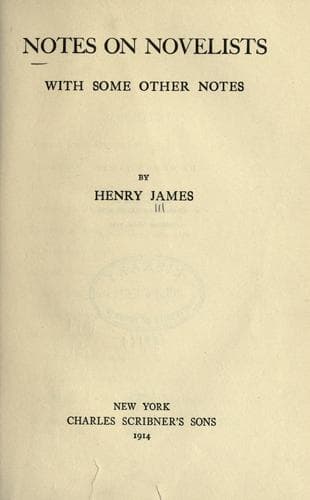
Notes on Novelists, with Some Other NotesJames, Henry
History
Notes on Novelists, with Some Other Notes
James, Henry
Fiction -- History and criticism; Novelists
It may seem odd to find a conscious melancholy in the fact that a great
worker succeeded in clasping his opportunity in such an embrace, this
being exactly our usual measure of the felicity of great workers. I
speak, I hasten to reassert, all in the name of sympathy—without which
it would have been detestable to speak at all; and the sentiment puts
its hand instinctively on the thing that makes it least futile. This
particular thing then is not in the least Balzac’s own hold of his
terrible mass of matter; it is absolutely the convolutions of the
serpent he had with a magnificent courage invited to wind itself round
him. We must use the common image—he had created his Frankenstein
monster. It is the fellow-craftsman who can most feel for him—it being
apparently possible to read him from another point of view without
getting really into his presence. We undergo with him from book to book,
from picture to picture, the convolutions of the serpent, we especially
whose refined performances are given, as we know, but with the small
common or garden snake. I stick to this to justify my image just above
of his having been “caged” by the intensity with which he saw his
general matter as a whole. To see it always as a whole is our wise, our
virtuous effort, the very condition, as we keep in mind, of superior
art. Balzac was in this connection then wise and virtuous to the most
exemplary degree; so that he doubtless ought logically but to prompt to
complacent reflections. No painter ever saw his general matter nearly so
much as a whole. Why is it then that we hover about him, if we are real
Balzacians, not with cheerful chatter, but with a consideration deeper
in its reach than any mere moralising? The reason is largely that if you
wish with absolute immaculate virtue to look at your matter as a whole
and yet remain a theme for cheerful chatter, you must be careful to take
some quantity that will not hug you to death. Balzac’s active intention
was, to vary our simile, a beast with a hundred claws, and the spectacle
is in the hugging process of which, as energy against energy, the beast
was capable. Its victim died of the process at fifty, and if what we see
in the long gallery in which it is mirrored is not the defeat, but the
admirable resistance, we none the less never lose the sense that the
fighter is shut up with his fate. He has locked himself in—it is
doubtless his own fault—and thrown the key away. Most of all perhaps
the impression comes—the impression of the adventurer committed and
anxious, but with no retreat—from the so formidably concrete nature of
his plastic stuff. When we work in the open, as it were, our material is
not classed and catalogued, so that we have at hand a hundred ways of
being loose, superficial, disingenuous, and yet passing, to our no small
profit, for remarkable. Balzac had no “open”; he held that the great
central normal fruitful country of his birth and race, overarched with
Public-domain text, read in full here on John Shaqi.
Reviews
Reviews
No reviews yet
Be the first to share your thoughts on this work.
Elsewhere in the archive
Join the Discussion
Join the discussion
Sign in to leave a comment or review.
Sign InorCreate an account