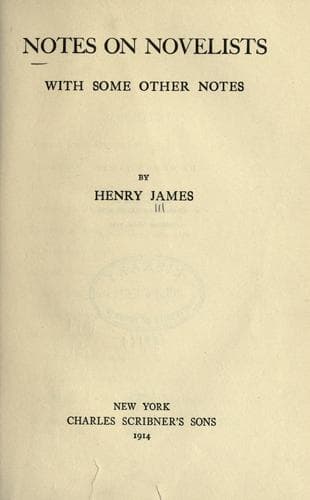
Notes on Novelists, with Some Other NotesJames, Henry
History
Notes on Novelists, with Some Other Notes
James, Henry
Fiction -- History and criticism; Novelists
Your letter had the most wonderful “I told you so” I ever heard
in the course of my life. Why, you madman, I wouldn’t change my
present installation for any post, dignity, honour, or advantage
conceivable to me. It fills the bill; I have the loveliest time.
And as for wars and rumours of wars, you surely know enough of
me to be aware that I like that also a thousand times better
than decrepit peace in Middlesex. I do not quite like politics.
I am too aristocratic, I fear, for that. God knows I don’t care
who I chum with; perhaps like sailors best; but to go round and
sue and sneak to keep a crowd together—never.
His categories satisfied him; he had got hold of “the world where men
still live a man’s life”—which was not, as we have just seen, that of
“cities, clubs and colleges.” He was supremely suited in short at
last—at the cost, it was to be said, of simplifications of view that,
intellectually, he failed quite exactly (it was one of his few
limitations) to measure; but in a way that ministered to his rare
capacity for growth and placed in supreme relief his affinity with the
universal romantic. It was not that anything could ever be for him plain
sailing, but that he had been able at forty to turn his life into the
fairytale of achieving, in a climate that he somewhere describes as “an
expurgated heaven,” such a happy physical consciousness as he had never
known. This enlarged in every way his career, opening the door still
wider to that real puss-in-the-corner game of opposites by which we have
critically the interest of seeing him perpetually agitated. Let me
repeat that these new volumes, from the date of his definite
expatriation, direct us for the details of the picture constantly to the
“Vailima Letters;” with as constant an effect of our thanking our
fortune—to say nothing of his own—that he should have had in these
years a correspondent and a confidant who so beautifully drew him out.
If he possessed in Mr. Sidney Colvin his literary chargé d’affaires at
home, the ideal friend and _alter ego_ on whom he could unlimitedly
rest, this is a proof the more—with the general rarity of such
cases—of what it was in his nature to make people wish to do for him.
To Mr. Colvin he is more familiar than to any one, more whimsical and
natural and frequently more inimitable—of all of which a just notion
can be given only by abundant citation. And yet citation itself is
embarrassed, with nothing to guide it but his perpetual spirits,
perpetual acuteness and felicity, restlessness of fancy and of judgment.
These things make him jump from pole to pole and fairly hum, at times,
among the objects and subjects that filled his air, like a charged bee
among flowers.
He is never more delightful than when he is most egotistic, most
consciously charmed with something he has done.
And the papers are some of them up to dick, and no mistake. I
agree with you, the lights seem a little turned down.
Public-domain text, read in full here on John Shaqi.
Reviews
Reviews
No reviews yet
Be the first to share your thoughts on this work.
Join the Discussion
Join the discussion
Sign in to leave a comment or review.
Sign InorCreate an account