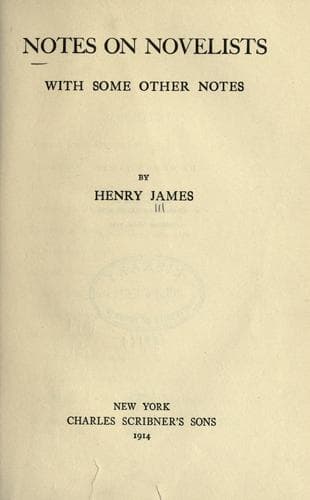
Notes on Novelists, with Some Other NotesJames, Henry
History
Notes on Novelists, with Some Other Notes
James, Henry
Fiction -- History and criticism; Novelists
its infinite social complexity, yielded a sufficiency of earth and sea
and sky. We seem to see as his catastrophe that the sky, all the same,
came down on him. He couldn’t keep it up—in more senses than one. These
are perhaps fine fancies for a critic to weave about a literary figure
of whom he has undertaken to give a plain account; but I leave them so
on the plea that there are relations in which, for the Balzacian,
criticism simply drops out. That is not a liberty, I admit, ever to be
much encouraged; critics in fact are the only people who have a right
occasionally to take it. There is no such plain account of the Comédie
Humaine as that it makes us fold up our yard-measure and put away our
note-book quite as we do with some extraordinary character, some
mysterious and various stranger, who brings with him his own standards
and his own air. There is a kind of eminent presence that abashes even
the interviewer, moves him to respect and wonder, makes him, for
consideration itself, not insist. This takes of course a personage sole
of his kind. But such a personage precisely is Balzac.
III
By all of which have I none the less felt it but too clear that I must
not pretend in this place to take apart the pieces of his immense
complicated work, to number them or group them or dispose them about.
The most we can do is to pick one up here and there and wonder, as we
weigh it in our hand, at its close compact substance. That is all even
M. Taine could do in the longest and most penetrating study of which our
author has been the subject. Every piece we handle is so full of stuff,
condensed like the edibles provided for campaigns and explorations,
positively so charged with distilled life, that we find ourselves
dropping it, in certain states of sensibility, as we drop an object
unguardedly touched that startles us by being animate. We seem really
scarce to want anything to _be_ so animate. It would verily take Balzac
to detail Balzac, and he has had in fact Balzacians nearly enough
affiliated to affront the task with courage. The “Répertoire de la
Comédie Humaine” of MM. Anatole Cerfberr and Jules Christophe is a
closely-printed octavo of 550 pages which constitutes in relation to his
characters great and small an impeccable biographical dictionary. His
votaries and expositors are so numerous that the Balzac library of
comment and research must be, of its type, one of the most copious. M.
de Lovenjoul has laboured all round the subject; his “Histoire des
Œuvres” alone is another crowded octavo of 400 pages; in connection with
which I must mention Miss Wormeley, the devoted American translator,
interpreter, worshipper, who in the course of her own studies has so
often found occasion to differ from M. de Lovenjoul on matters of fact
and questions of date and of appreciation. Miss Wormeley, M. Paul
Bourget and many others are examples of the passionate piety that our
author can inspire.
Public-domain text, read in full here on John Shaqi.
Reviews
Reviews
No reviews yet
Be the first to share your thoughts on this work.
Elsewhere in the archive
Join the Discussion
Join the discussion
Sign in to leave a comment or review.
Sign InorCreate an account