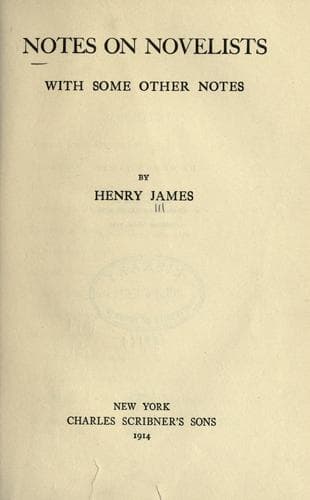
Notes on Novelists, with Some Other NotesJames, Henry
History
Notes on Novelists, with Some Other Notes
James, Henry
Fiction -- History and criticism; Novelists
As I turn over the encyclopedia of his characters I
note that whereas such works usually commemorate but the ostensibly
eminent of a race and time, every creature so much as named in the
fictive swarm is in this case preserved to fame: so close is the
implication that to have _been_ named by such a dispenser of life and
privilege is to be, as we say it of baronets and peers, created. He
infinitely divided moreover, as we know, he subdivided, altered and
multiplied his heads and categories—his “Vie Parisienne,” his “Vie de
Province,” his “Vie Politique,” his “Parents Pauvres,” his “Études
Philosophiques,” his “Splendeurs et Misères des Courtisanes,” his
“Envers de l’Histoire Contemporaine” and all the rest; so that nominal
reference to them becomes the more difficult. Yet without prejudice
either to the energy of conception with which he mapped out his theme as
with chalk on a huge blackboard, or to the prodigious patience with
which he executed his plan, practically filling in with a wealth of
illustration, from sources that to this day we fail to make out, every
compartment of his table, M. de Lovenjoul draws up the list, year by
year, from 1822 to 1848, of his mass of work, giving us thus the measure
of the tension represented for him by almost any twelvemonth. It is
wholly unequalled, considering the quality of Balzac’s show, by any
other eminent abundance.
I must be pardoned for coming back to it, for seeming unable to leave
it; it enshrouds so interesting a mystery. How was so solidly systematic
a literary attack on life to be conjoined with whatever workable minimum
of needful intermission, of free observation, of personal experience?
Some small possibility of personal experience and disinterested life
must, at the worst, from deep within or far without, feed and fortify
the strained productive machine. These things were luxuries that Balzac
appears really never to have tasted on any appreciable scale. His
published letters—the driest and most starved of those of any man of
equal distinction—are with the exception of those to Madame de Hanska,
whom he married shortly before his death, almost exclusively the audible
wail of a galley-slave chained to the oar. M. Zola, in our time, among
the novelists, has sacrificed to the huge plan in something of the same
manner, yet with goodly modern differences that leave him a
comparatively simple instance. His work assuredly has been more nearly
dried up by the sacrifice than ever Balzac’s was—so miraculously, given
the conditions, was Balzac’s to escape the anti-climax. Method and
system, in the chronicle of the tribe of Rougon-Macquart, an economy in
itself certainly of the rarest and most interesting, have spread so from
centre to circumference that they have ended by being almost the only
thing we feel. And then M. Zola has survived and triumphed in his
lifetime, has continued and lasted, has piled up and, if the remark be
not frivolous, enjoyed in all its _agréments_ the reward for which
Public-domain text, read in full here on John Shaqi.
Reviews
Reviews
No reviews yet
Be the first to share your thoughts on this work.
Elsewhere in the archive
Join the Discussion
Join the discussion
Sign in to leave a comment or review.
Sign InorCreate an account