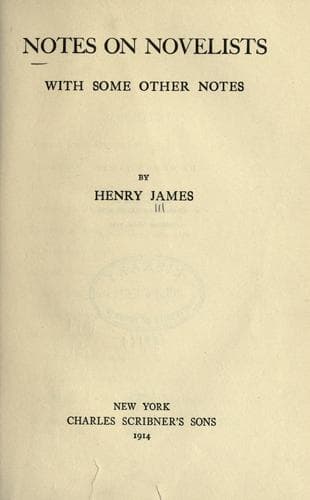
Notes on Novelists, with Some Other NotesJames, Henry
History
Notes on Novelists, with Some Other Notes
James, Henry
Fiction -- History and criticism; Novelists
Balzac toiled and sweated in vain. On top of which he will have had also
his literary great-grandfather’s heroic example to start from and profit
by, the positive heritage of a _fils de famille_ to enjoy, spend, save,
waste. Balzac had frankly no heritage at all but his stiff subject, and
by way of model not even in any direct or immediate manner that of the
inner light and kindly admonition of his genius. Nothing adds more to
the strangeness of his general performance than his having failed so
long to find his inner light, groped for it almost ten years, missed it
again and again, moved straight away from it, turned his back on it,
lived in fine round about it, in a darkness still scarce penetrable, a
darkness into which we peep only half to make out the dreary little
waste of his numerous _œuvres de jeunesse_. To M. Zola was vouchsafed
the good fortune of settling down to the Rougon-Macquart with the
happiest promptitude; it was as if time for one look about him—and I
say it without disparagement to the reach of his look—had sufficiently
served his purpose. Balzac moreover might have written five hundred
novels without our feeling in him the faintest hint of the breath of
doom, if he had only been comfortably capable of conceiving the short
cut of the fashion practised by others under his eyes. As Alexandre
Dumas and George Sand, illustrious contemporaries, cultivated a personal
life and a disinterested consciousness by the bushel, having, for their
easier duration, not too consistently known, as the true painter knows
it, the obsession of the thing to be done, so Balzac was condemned by
his constitution itself, by his inveterately seeing this “thing to be
done” as part and parcel, as of the very essence, of his enterprise. The
latter existed for him, as the process worked and hallucination settled,
in the form, and the form only, of the thing done, and not in any
hocus-pocus about doing. There was no kindly convenient escape for him
by the little swinging back-door of the thing _not_ done. He desired—no
man more—to get out of his obsession, but only at the other end, that
is by boring through it. “How then, thus deprived of the outer air
almost as much as if he were gouging a passage for a railway through an
Alp, _did_ he live?” is the question that haunts us—with the
consequence for the most part of promptly meeting its fairly tragic
answer. He did _not_ live—save in his imagination, or by other aid than
he could find there; his imagination was all his experience; he had
provably no time for the real thing. This brings us to the rich if
simple truth that his imagination alone did the business, carried
through both the conception and the execution—as large an effort and as
proportionate a success, in all but the vulgar sense, as the faculty
when equally handicapped was ever concerned in. Handicapped I say
because this interesting fact about him, with the claim it makes, rests
Public-domain text, read in full here on John Shaqi.
Reviews
Reviews
No reviews yet
Be the first to share your thoughts on this work.
Elsewhere in the archive
Join the Discussion
Join the discussion
Sign in to leave a comment or review.
Sign InorCreate an account