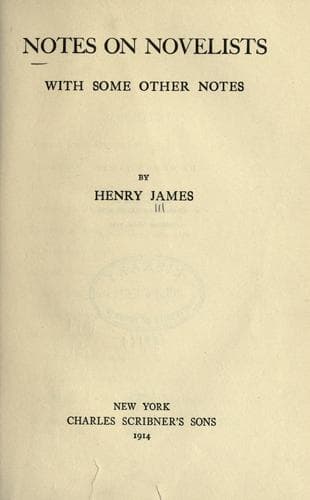
Notes on Novelists, with Some Other NotesJames, Henry
History
Notes on Novelists, with Some Other Notes
James, Henry
Fiction -- History and criticism; Novelists
on the ground, the high distinction, that more than all the rest of us
put together he went in, as we say, for detail, circumstance and
specification, proposed to himself _all_ the connections of every part
of his matter and the full total of the parts. The whole thing, it is
impossible not to keep repeating, was what he deemed treatable. One
really knows in all imaginative literature no undertaking to compare
with it for courage, good faith and sublimity. There, once more, was the
necessity that rode him and that places him apart in our homage. It is
no light thing to have been condemned to become provably sublime. And
looking through, or trying to, at what is beneath and behind, we are
left benevolently uncertain if the predominant quantity be audacity or
innocence.
It is of course inevitable at this point to seem to hear the colder
critic promptly take us up. He undertook the whole thing—oh exactly,
the ponderous person! But _did_ he “do” the whole thing, if you please,
any more than sundry others of fewer pretensions? The retort to this it
can only be a positive joy to make, so high a note instantly sounds as
an effect of the inquiry. Nothing is more interesting and amusing than
to find one’s self recognising both that Balzac’s pretensions were
immense, portentous, and that yet, taking him—and taking
_them_—altogether, they but minister in the long run to our fondness.
They affect us not only as the endearing eccentricities of a person we
greatly admire, but fairly as the very condition of his having become
such a person. We take them thus in the first place for the very terms
of his plan, and in the second for a part of that high robustness and
that general richness of nature which made him in face of such a project
believe in himself. One would really scarce have liked to see such a job
as La Comédie Humaine tackled without swagger. To think of the thing
really as practicable _was_ swagger, and of the very rarest order. So to
think assuredly implied pretensions, pretensions that risked showing as
monstrous should the enterprise fail to succeed. It is for the colder
critic to take the trouble to make out that of the two parties to it the
body of pretension remains greater than the success. One may put it
moreover at the worst for him, may recognise that it is in the matter of
opinion still more than in the matter of knowledge that Balzac offers
himself as universally competent. He has flights of judgment—on
subjects the most special as well as the most general—that are
vertiginous and on his alighting from which we greet him with a special
indulgence. We can easily imagine him to respond, confessing
humorously—if he had only time—to such a benevolent understanding
smile as would fain hold our own eyes a moment. Then it is that he would
most show us his scheme and his necessities and how in operation they
all hang together. _Naturally_ everything about everything, though how
Public-domain text, read in full here on John Shaqi.
Reviews
Reviews
No reviews yet
Be the first to share your thoughts on this work.
Elsewhere in the archive
Join the Discussion
Join the discussion
Sign in to leave a comment or review.
Sign InorCreate an account