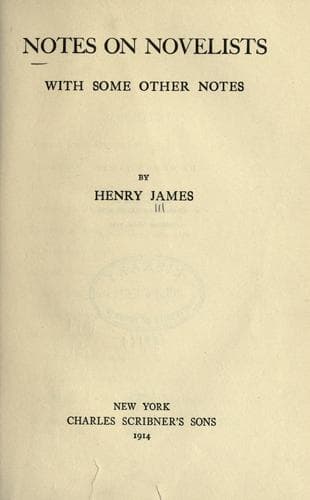
Notes on Novelists, with Some Other NotesJames, Henry
History
Notes on Novelists, with Some Other Notes
James, Henry
Fiction -- History and criticism; Novelists
he had time to learn it is the last thing he has time to tell us; which
matters the less, moreover, as it is not over the question of his
knowledge that we sociably invite him, as it were (and remembering the
two augurs behind the altar) to wink at us for a sign. His convictions
it is that are his great pardonable “swagger”; to them in particular I
refer as his general operative condition, the constituted terms of his
experiment, and not less as his consolation, his support, his amusement
by the way. They embrace everything in the world—that is in his world
of the so parti-coloured France of his age: religion, morals, politics,
economics, physics, esthetics, letters, art, science, sociology, every
question of faith, every branch of research. They represent thus his
equipment of ideas, those ideas of which it will never do for a man who
aspires to constitute a State to be deprived. He must take them with him
as an ambassador extraordinary takes with him secretaries, uniforms,
stars and garters, a gilded coach and a high assurance. Balzac’s
opinions are his gilded coach, in which he is more amused than anything
else to feel himself riding, but which is indispensably concerned in
getting him over the ground. What more inevitable than that they should
be intensely Catholic, intensely monarchical, intensely saturated with
the real genius—as between 1830 and 1848 he believed it to be—of the
French character and French institutions?
Nothing is happier for us than that he should have enjoyed his outlook
before the first half of the century closed. He could then still treat
his subject as comparatively homogeneous. Any country could have a
Revolution—every country _had_ had one. A Restoration was merely what a
revolution involved, and the Empire had been for the French but a
revolutionary incident, in addition to being by good luck for the
novelist an immensely pictorial one. He was free therefore to arrange
the background of the comedy in the manner that seemed to him best to
suit anything so great; in the manner at the same time prescribed
according to his contention by the noblest traditions. The church, the
throne, the noblesse, the bourgeoisie, the people, the peasantry, all in
their order and each solidly kept in it, these were precious things,
things his superabundant insistence on the price of which is what I
refer to as his exuberance of opinion. It was a luxury for more reasons
than one, though one, presently to be mentioned, handsomely
predominates. The meaning of that exchange of intelligences in the rear
of the oracle which I have figured for him with the perceptive friend
bears simply on his pleading guilty to the purport of the friend’s
discrimination. The point the latter makes with him—a beautiful cordial
critical point—is that he truly cares for nothing in the world, thank
goodness, so much as for the passions and embroilments of men and women,
the free play of character and the sharp revelation of type, all the
Public-domain text, read in full here on John Shaqi.
Reviews
Reviews
No reviews yet
Be the first to share your thoughts on this work.
Elsewhere in the archive
Join the Discussion
Join the discussion
Sign in to leave a comment or review.
Sign InorCreate an account