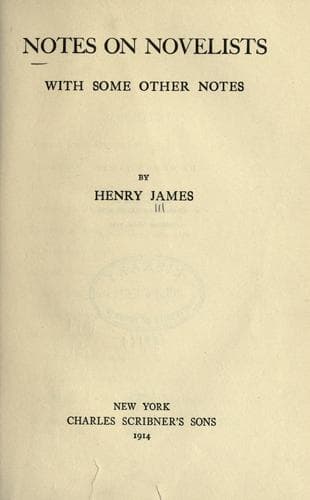
Notes on Novelists, with Some Other NotesJames, Henry
History
Notes on Novelists, with Some Other Notes
James, Henry
Fiction -- History and criticism; Novelists
real stuff of drama and the natural food of novelists. Religion, morals,
politics, economics, esthetics would be thus, as systematic matter, very
well in their place, but quite secondary and subservient. Balzac’s
attitude is again and again that he cares for the adventures and
emotions because, as his last word, he cares for the good and the
greatness of the State—which is where his swagger, with a whole society
on his hands, comes in. What we on our side in a thousand places
gratefully feel is that he cares for his monarchical and hierarchical
and ecclesiastical society because it rounds itself for his mind into
the most congruous and capacious theatre for the repertory of his
innumerable comedians. It has above all, for a painter abhorrent of the
superficial, the inestimable benefit of the accumulated, of strong marks
and fine shades, contrasts and complications. There had certainly been
since 1789 dispersals and confusions enough, but the thick tradition, no
more at the most than half smothered, lay under them all. So the whole
of his faith and no small part of his working omniscience were neither
more nor less than that historic sense which I have spoken of as the
spur of his invention and which he possessed as no other novelist has
done. We immediately feel that to name it in connection with him is to
answer every question he suggests and to account for each of his
idiosyncrasies in turn. The novel, the tale, however brief, the passage,
the sentence by itself, the situation, the person, the place, the motive
exposed, the speech reported—these things were in his view history,
with the absoluteness and the dignity of history. This is the source
both of his weight and of his wealth. What is the historic sense after
all but animated, but impassioned knowledge seeking to enlarge itself? I
have said that his imagination did the whole thing, no other
explanation—no reckoning of the possibilities of personal
saturation—meeting the mysteries of the case. Therefore his imagination
achieved the miracle of absolutely resolving itself into multifarious
knowledge. Since history proceeds by documents he constructed, as he
needed them, the documents too—fictive sources that imitated the actual
to the life. It was of course a terrible business, but at least in the
light of it his claims to creatorship are justified—which is what was
to be shown.
IV
Public-domain text, read in full here on John Shaqi.
Reviews
Reviews
No reviews yet
Be the first to share your thoughts on this work.
Elsewhere in the archive
Join the Discussion
Join the discussion
Sign in to leave a comment or review.
Sign InorCreate an account