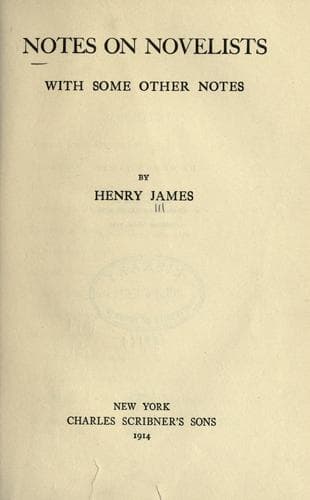
Notes on Novelists, with Some Other NotesJames, Henry
History
Notes on Novelists, with Some Other Notes
James, Henry
Fiction -- History and criticism; Novelists
It is very well even in the sketchiest attempt at a portrait of his
genius to try to take particulars in their order: one peeps over the
shoulder of another at the moment we get a feature into focus. The loud
appeal not to be left out prevails among them all, and certainly with
the excuse that each as we fix it seems to fall most into the picture. I
have so indulged myself as to his general air that I find a whole list
of vivid contributive marks almost left on my hands. Such a list, in any
study of Balzac, is delightful for intimate edification as well as for
the fine humour of the thing; we proceed from one of the items of his
breathing physiognomy to the other with quite the same sense of life,
the same active curiosity, with which we push our way through the thick
undergrowth of one of the novels. The difficulty is really that the
special point for which we at the moment observe him melts into all the
other points, is swallowed up before our eyes in the formidable mass.
The French apply the happiest term to certain characters when they speak
of them as _entiers_, and if the word had been invented for Balzac it
could scarce better have expressed him. He is “entire” as was never a
man of his craft; he moves always in his mass; wherever we find him we
find him in force; whatever touch he applies he applies it with his
whole apparatus. He is like an army gathered to besiege a cottage
equally with a city, and living voraciously in either case on all the
country about. It may well be, at any rate, that his infatuation with
the idea of the social, the practical primacy of “the sex” is the
article at the top of one’s list; there could certainly be no better
occasion than this of a rich reissue of the “Deux Jeunes Mariées” for
placing it there at a venture. Here indeed precisely we get a sharp
example of the way in which, as I have just said, a capital illustration
of one of his sides becomes, just as we take it up, a capital
illustration of another. The correspondence of Louise de Chaulieu and
Renée de Maucombe is in fact one of those cases that light up with a
great golden glow all his parts at once. We needn’t mean by this that
such parts are themselves absolutely all golden—given the amount of
tinsel for instance in his view, supereminent, transcendent here, of the
old families and the great ladies. What we do convey, however, is that
his creative temperament finds in such _data_ as these one of its best
occasions for shining out. Again we fondly recognise his splendid, his
attaching swagger—that of a “bounder” of genius and of feeling; again
we see how, with opportunity, its elements may vibrate into a perfect
ecstasy of creation.
Public-domain text, read in full here on John Shaqi.
Reviews
Reviews
No reviews yet
Be the first to share your thoughts on this work.
Elsewhere in the archive
Join the Discussion
Join the discussion
Sign in to leave a comment or review.
Sign InorCreate an account