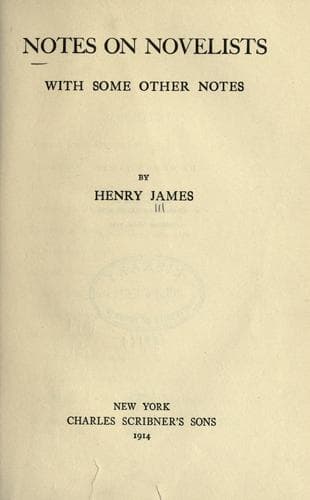
Notes on Novelists, with Some Other NotesJames, Henry
History
Notes on Novelists, with Some Other Notes
James, Henry
Fiction -- History and criticism; Novelists
Why shouldn’t a man swagger, he treats us to the diversion of asking
ourselves, who has created from top to toe the most brilliant, the most
historic, the most insolent, above all the most detailed and
discriminated of aristocracies? Balzac carried the uppermost class of
his comedy, from the princes, dukes, and unspeakable duchesses down to
his poor barons _de province_, about in his pocket as he might have
carried a tolerably befingered pack of cards, to deal them about with a
flourish of the highest authority whenever there was the chance of a
game. He knew them up and down and in and out, their arms, infallibly
supplied, their quarterings, pedigrees, services, intermarriages,
relationships, ramifications and other enthralling attributes. This
indeed is comparatively simple learning; the real wonder is rather when
we linger on the ground of the patrician consciousness itself, the
innermost, the esoteric, the spirit, temper, tone—tone above all—of
the titled and the proud. The questions multiply for every scene of the
comedy; there is no one who makes us walk in such a cloud of them. The
clouds elsewhere, in comparison, are at best of questions not worth
asking. _Was_ the patrician consciousness that figured as our author’s
model so splendidly fatuous as he—almost without irony, often in fact
with a certain poetic sympathy—everywhere represents it? His
imagination lives in it, breathes its scented air, swallows this element
with the smack of the lips of the connoisseur; but I feel that we never
know, even to the end, whether he be here directly historic or only
quite misguidedly romantic. The romantic side of him has the extent of
all the others; it represents in the oddest manner his escape from the
walled and roofed structure into which he had built himself—his longing
for the vaguely-felt outside and as much as might be of the rest of the
globe. But it is characteristic of him that the most he could do for
this relief was to bring the fantastic into the circle and fit it
somehow to his conditions. Was his tone for the duchess, the marquise
but the imported fantastic, one of those smashes of the window-pane of
the real that reactions sometimes produce even in the stubborn? or are
we to take it as observed, as really reported, as, for all its
difference from our notion of the natural—and, quite as much, of the
artificial—in another and happier strain of manners, substantially
true? The whole episode, in “Les Illusions Perdues,” of Madame de
Bargeton’s “chucking” Lucien de Rubempré, on reaching Paris with him,
under pressure of Madame d’Espard’s shockability as to his coat and
trousers and other such matters, is either a magnificent lurid document
or the baseless fabric of a vision. The great wonder is that, as I
rejoice to put in, we can never really discover which, and that we feel
as we read that we can’t, and that we suffer at the hands of no other
author this particular helplessness of immersion. It is _done_—we are
Public-domain text, read in full here on John Shaqi.
Reviews
Reviews
No reviews yet
Be the first to share your thoughts on this work.
Elsewhere in the archive
Join the Discussion
Join the discussion
Sign in to leave a comment or review.
Sign InorCreate an account