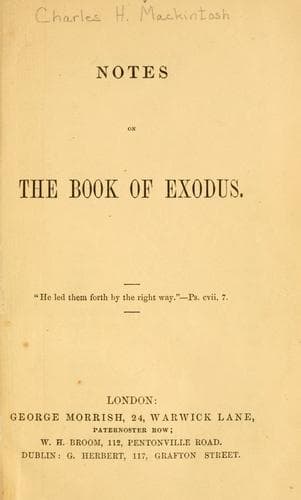
Notes on the book of ExodusMackintosh, Charles Henry
Religion
Notes on the book of Exodus
Mackintosh, Charles Henry
Bible. Exodus -- Commentaries
First, in his personal character, there is much, very much, for us to
learn. God had not only to raise him up, but also to train him, in one
way or another, for the lengthened period of eighty years, first in
the house of Pharaoh's daughter, and then at "the backside of the
desert." This, to our shallow thoughts, would seem an immense space of
time to devote to the education of a minister of God. But then God's
thoughts are not as our thoughts. He knew the need of those forty
years twice told, in the preparation of His chosen vessel. When God
educates, He educates in a manner worthy of Himself and His most holy
service. He will not have a novice to do His work. The servant of
Christ has to learn many a lesson, to undergo many an exercise, to
pass through many a conflict, in secret, ere he is really qualified to
act in public. Nature does not like this. It would rather figure in
public than learn in private,--it would rather be gazed upon and
admired by the eye of man than be disciplined by the hand of God. But
it will not do. We must take God's way. Nature may rush into the scene
of operation; but God does not want it there. It must be withered,
crushed, set aside. The place of death is the place for nature. If it
_will_ be active, God will so order matters, in His infallible
faithfulness and perfect wisdom, that the results of its activity will
prove its utter defeat and confusion. He knows what to do with nature,
where to put it, and where to keep it. O, that we may all be in deeper
communion with the mind of God, in reference to self and all that
pertains thereto! Then shall we make fewer mistakes; then shall our
path be steady and elevated, our spirit tranquil, and our service
effective.
"And it came to pass in those days, when Moses was grown, that he
went out unto his brethren, and looked on their burdens; and he spied
an Egyptian smiting a Hebrew, one of his brethren. And he looked this
way and that way, and when he saw there was no man, he slew the
Egyptian, and hid him in the sand." This was zeal for his brethren;
but it was "not according to knowledge." God's time was not yet come
for judging Egypt and delivering Israel; and the intelligent servant
will ever wait for God's time. "Moses was grown," and "he was learned
in all the wisdom of the Egyptians;" and, moreover, "he supposed his
brethren would have understood how that God by his hand would deliver
them." All this was true; yet he evidently ran before the time, and
when one does this, failure must be the issue.[2]
Public-domain text, read in full here on John Shaqi.
Reviews
Reviews
No reviews yet
Be the first to share your thoughts on this work.
Join the Discussion
Join the discussion
Sign in to leave a comment or review.
Sign InorCreate an account