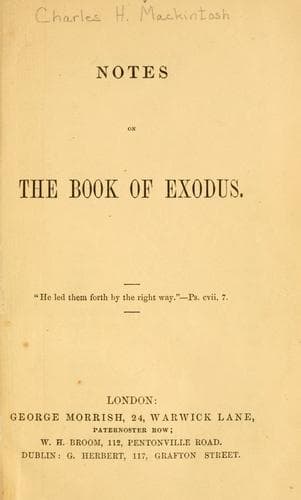
Notes on the book of ExodusMackintosh, Charles Henry
Religion
Notes on the book of Exodus
Mackintosh, Charles Henry
Bible. Exodus -- Commentaries
[2] In Stephen's address to the council at Jerusalem, there is an
allusion to Moses' acting, to which it may be well to advert. "And
when he was full forty years old, it came into his heart to visit his
brethren the children of Israel. And seeing one of them suffer wrong,
he defended him, and avenged him that was oppressed, and smote the
Egyptian; for he supposed his brethren would have understood how that
God by his hand would deliver them; but they understood not." (Acts
vii. 23-35.) It is evident that Stephen's object, in his entire
address, was to bring the history of the nation to bear upon the
consciences of those whom he had before him; and it would have been
quite foreign to this object, and at variance with the Spirit's rule
in the New Testament, to raise a question as to whether Moses had not
acted before the divinely appointed time.
Moreover, he merely says, "it came into his heart to visit his
brethren." He does not say that God sent him, _at that time_. Nor does
this, in the least, touch the question of the moral condition of those
who rejected him. "They understood not." This was the fact as to them,
whatever Moses might have personally to learn in the matter. The
spiritual mind can have no difficulty in apprehending this.
Looking at Moses typically, we can see the mission of Christ to
Israel, and their rejection of Him, and refusal to have Him to reign
over them. On the other hand, looking at Moses personally, we find
that he, like others, made mistakes and displayed
infirmities,--sometimes went too fast and sometimes too slow. All this
is easily understood, and only tends to magnify the infinite grace and
exhaustless patience of God.
And not only is there failure in the end, but also manifest
uncertainty, and lack of calm elevation and holy independence in the
progress of a work begun before God's time. Moses "_looked this way
and that way_." There is no need of this when a man is acting with and
for God, and in the full intelligence of His mind, as to the detail of
his work. If God's time had really come, and if Moses was conscious of
being divinely commissioned to execute judgment upon the Egyptian, and
if he felt assured of the divine presence with him, he would not have
"looked this way and that way."
Public-domain text, read in full here on John Shaqi.
Reviews
Reviews
No reviews yet
Be the first to share your thoughts on this work.
Join the Discussion
Join the discussion
Sign in to leave a comment or review.
Sign InorCreate an account