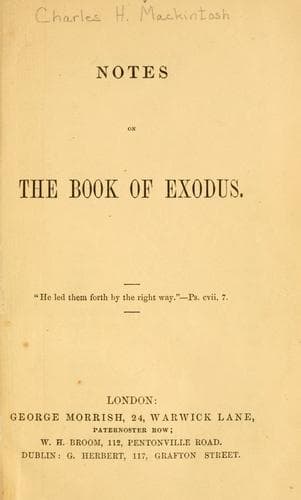
Notes on the book of ExodusMackintosh, Charles Henry
Religion
Notes on the book of Exodus
Mackintosh, Charles Henry
Bible. Exodus -- Commentaries
In contemplating the path of Moses, we observe how that faith led him
entirely athwart the ordinary course of nature. It led him to despise
all the pleasures, the attractions, and the honors of Pharaoh's court.
And not only that, but also to relinquish an apparently wide sphere of
usefulness. Human expediency would have conducted him along quite an
opposite path. It would have led him to use his influence on behalf of
the people of God--to act _for_ them instead of suffering _with_ them.
According to man's judgment, providence would seem to have opened for
Moses a wide and most important sphere of labor; and surely, if ever
the hand of God was manifest in placing a man in a distinct position,
it was in his case. By a most marvelous interposition--by a most
unaccountable chain of circumstances, every link of which displayed
the finger of the Almighty--by an order of events which no human
foresight could have arranged, had the daughter of Pharaoh been made
the instrument of drawing Moses out of the water, and of nourishing
and educating him until he was "full forty years old." With all these
circumstances in his view, to abandon his high, honorable, and
influential position, could only be regarded as the result of a
misguided zeal which no sound judgment could approve.
Thus might poor blind nature reason. But faith thought differently;
for nature and faith are always at issue. They cannot agree upon a
single point. Nor is there anything, perhaps, in reference to which
they differ so widely as what are commonly called "openings of
providence." Nature will constantly regard such openings as warrants
for self-indulgence; whereas faith will find in them opportunities for
self-denial. Jonah might have deemed it a very remarkable opening of
providence to find a ship going to Tarshish; but, in truth, it was an
opening through which he slipped off the path of obedience.
No doubt it is the Christian's privilege to see his Father's hand, and
hear His voice, in everything; but he is not to be guided by
circumstances. A Christian so guided is like a vessel at sea without
rudder or compass; she is at the mercy of the waves and the winds.
God's promise to His child is, "I will guide thee with Mine eye." (Ps.
xxxii. 8.) His warning is, "Be not as the horse or as the mule, which
have no understanding; whose mouth must be held in with bit and
bridle, lest they come near unto thee." It is much better to be
guided by our Father's eye than by the bit and bridle of
circumstances; and we know that, in the ordinary acceptation of the
term, "providence" is only another word for the impulse of
circumstances.
Public-domain text, read in full here on John Shaqi.
Reviews
Reviews
No reviews yet
Be the first to share your thoughts on this work.
Join the Discussion
Join the discussion
Sign in to leave a comment or review.
Sign InorCreate an account