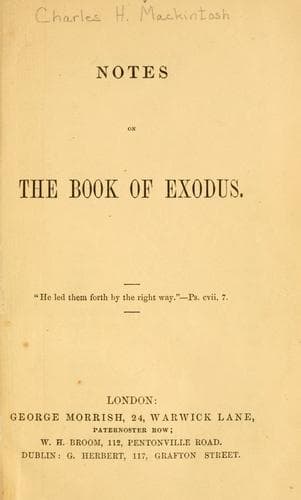
Notes on the book of ExodusMackintosh, Charles Henry
Religion
Notes on the book of Exodus
Mackintosh, Charles Henry
Bible. Exodus -- Commentaries
Now, the power of faith may constantly be seen in refusing and
forsaking the apparent openings of providence. It was so in the case
of Moses. "By faith he refused to be called the son of Pharaoh's
daughter," and "by faith he forsook Egypt." Had he judged according to
the sight of his eyes, he would have grasped at the proffered dignity,
as the manifest gift of a kind providence, and he would have remained
in the court of Pharaoh as in a sphere of usefulness plainly thrown
open to him by the hand of God. But, then, he walked by faith, and not
by the sight of his eyes; and hence he forsook all. Noble example! May
we have grace to follow it!
And observe what it was that Moses "esteemed greater riches than the
treasures in Egypt;" it was the "reproach of Christ." It was not
merely reproach _for_ Christ. "The reproaches of them that reproached
Thee have fallen upon Me." The Lord Jesus, in perfect grace,
identified Himself with His people. He came down from heaven, leaving
His Father's bosom, and laying aside all His glory, He took His
people's place, confessed their sins, and bore their judgment on the
cursed tree. Such was His voluntary devotedness; He not merely acted
_for_ us, but made Himself one _with_ us, thus perfectly delivering us
from all that was or could be against us.
Hence we see how much in sympathy Moses was with the spirit and mind
of Christ in reference to the people of God. He was in the midst of
all the ease, the pomp, and dignity of Pharaoh's house, where "the
pleasures of sin," and "the treasures of Egypt," lay scattered around
him in richest profusion. All these things he might have enjoyed if he
would. He could have lived and died in the midst of wealth and
splendor; his entire path, from first to last, might, if he had
chosen, have been enlightened by the sunshine of royal favor: but that
would not have been "faith;" it would not have been Christlike. From
his elevated position, he saw his brethren bowed down beneath their
heavy burden, and faith led him to see that his place was to be _with_
them. Yes; with them, in all their reproach, their bondage, their
degradation, and their sorrow. Had he been actuated by mere
benevolence, philanthropy, or patriotism, he might have used his
personal influence on behalf of his brethren. He might have succeeded
in inducing Pharaoh to lighten their burden, and render their path
somewhat smoother, by royal grants in their favor; but this would
never do, never satisfy a heart that had a single pulsation in common
with the heart of Christ. Such a heart Moses, by the grace of God,
carried in his bosom; and, therefore, with all the energies and all
the affections of that heart, he threw himself, body, soul, and
spirit, into the very midst of his oppressed brethren. He "chose
rather to suffer affliction _with_ the people of God." And, moreover,
he did this by "faith."
Public-domain text, read in full here on John Shaqi.
Reviews
Reviews
No reviews yet
Be the first to share your thoughts on this work.
Join the Discussion
Join the discussion
Sign in to leave a comment or review.
Sign InorCreate an account