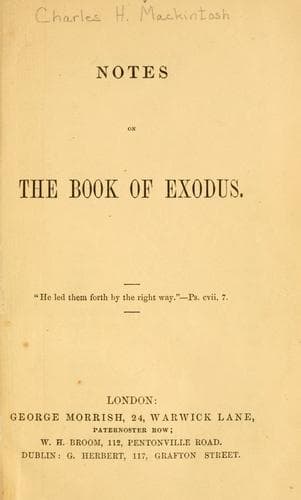
Notes on the book of ExodusMackintosh, Charles Henry
Religion
Notes on the book of Exodus
Mackintosh, Charles Henry
Bible. Exodus -- Commentaries
[3] There are two distinct unities spoken of in John xvii. 21, 23. The
first is that unity which the Church is responsible to have
maintained, but in which she has utterly failed. The second is that
unity which God will infallibly accomplish, and which He will manifest
in glory. If the reader will turn to the passage, he will at once see
the difference, both as to character and result, of the two.
Such, then, is the Church's high and holy position. She is one with
Him who is cast out by this world, but who occupies the throne of the
Majesty in the heavens. The Lord Jesus made Himself responsible for
her on the cross, in order that she might share with Him His present
rejection and His future glory. Would that all who form a part of such
a highly privileged body were more impressed with a sense of what
becomes them as to course and character down here! Assuredly, there
should be a fuller and clearer response, on the part of all the
children of God, to that love wherewith He has loved them, to that
salvation wherewith He has saved them, and to that dignity wherewith
He has invested them. The walk of the Christian should ever be the
natural result of realized privilege, and not the constrained result
of legal vows and resolutions,--the proper fruit of a position known
and enjoyed by faith, and not the fruit of one's own efforts to reach
a position "by works of law." All true believers _are_ a part of the
bride of Christ; hence, they owe Him those affections which become
that relation. The relationship is not obtained because of the
affections, but the affections flow out of the relationship.
So let it be, O Lord, with all Thy beloved and blood-bought people!
CHAPTER III.
We shall now resume the personal history of Moses, and contemplate him
during that deeply interesting period of his career which he spent in
retirement--a period including, as we should say, forty of his very
best years--the prime of life. This is full of meaning. The Lord had
graciously, wisely, and faithfully led His dear servant apart from the
eyes and thoughts of men, in order that He might train him under His
own immediate hand. Moses needed this. True, he had spent forty years
in the house of Pharaoh; and, while his sojourn there was not without
its influence and value, yet was it as nothing when compared with his
sojourn in the desert. The former might be valuable; but the latter
was indispensable.
Public-domain text, read in full here on John Shaqi.
Reviews
Reviews
No reviews yet
Be the first to share your thoughts on this work.
Join the Discussion
Join the discussion
Sign in to leave a comment or review.
Sign InorCreate an account