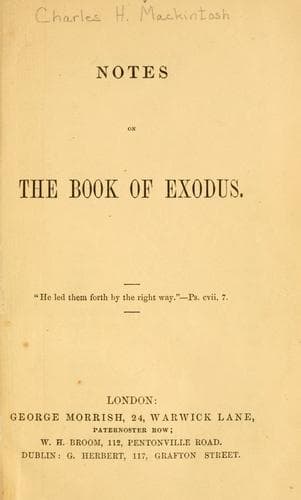
Notes on the book of ExodusMackintosh, Charles Henry
Religion
Notes on the book of Exodus
Mackintosh, Charles Henry
Bible. Exodus -- Commentaries
The personal character and actings of this honored servant of God will
come before us again in the next section of our book. We shall here
briefly consider him as a type of the Lord Jesus Christ. That he was a
type of Him is evident from the following passage,--"The Lord thy God
will raise up unto thee a Prophet from the midst of thee, of thy
brethren, like unto me; unto Him ye shall hearken." (Deut. xviii. 15.)
We are not, therefore, trafficking in human imagination in viewing
Moses as a type; it is the plain teaching of Scripture, and in the
closing verses of Exodus ii. we see this type in a double way: first,
in the matter of his rejection by Israel; and secondly, in his union
with a stranger in the land of Midian.
These points have already been, in some measure, developed in the
history of Joseph, who, being cast out by his brethren according to
the flesh, forms an alliance with an Egyptian bride. Here, as in the
case of Moses, we see shadowed forth Christ's rejection by Israel, and
His union with the Church, but in a different phase. In Joseph's case,
we have the exhibition of positive enmity against his _person_: in
Moses, it is the rejection of his _mission_. In Joseph's case, we
read, "They hated _him_, and could not speak peaceably unto _him_."
(Gen. xxxvii. 4.) In the case of Moses, the word is,--"_Who made thee
a prince and a judge over us?_" In short, the former was personally
hated; the latter, officially refused.
So also in the mode in which the great mystery of the Church is
exemplified in the history of those two Old Testament saints.
"Asenath" presents quite a different phase of the Church from that
which we have in the person of "Zipporah." The former was united to
Joseph in the time of his exaltation; the latter was the companion of
Moses in the obscurity of his desert life. (Comp. Gen. xli. 41-45 with
Exod. ii. 15; iii. 1.) True, both Joseph and Moses were, at the time
of their union with a stranger, rejected by their brethren; yet the
former was "governor over all the land of Egypt;" whereas the latter
tended a few sheep at "the backside of the desert."
Whether, therefore, we contemplate Christ as manifested in glory, or
as hidden from the world's gaze, the Church is intimately associated
with Him. And now, inasmuch as the world seeth Him not, neither can it
take knowledge of that body which is wholly one with Him. "The world
knoweth us not, because it knew Him not." (1 John iii. 1.) By and by,
Christ will appear in His glory, and the Church _with_ Him. "When
Christ our life shall appear, then shall ye also appear _with_ Him in
glory." (Col. iii. 4.) And again, "The glory which Thou gavest Me I
have given them; that they may be one, even as We are one: I in them,
and Thou in Me, that they may be made perfect in one; and that the
world may know that Thou hast sent Me, and hast loved them as Thou
hast loved Me." (John xvii. 22, 23.)[3]
Public-domain text, read in full here on John Shaqi.
Reviews
Reviews
No reviews yet
Be the first to share your thoughts on this work.
Join the Discussion
Join the discussion
Sign in to leave a comment or review.
Sign InorCreate an account