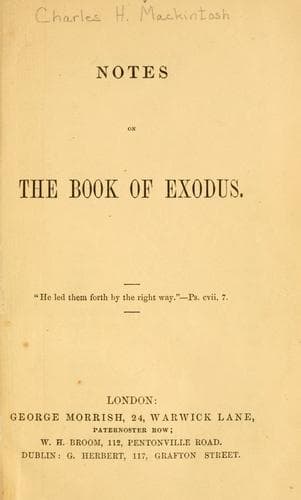
Notes on the book of ExodusMackintosh, Charles Henry
Religion
Notes on the book of Exodus
Mackintosh, Charles Henry
Bible. Exodus -- Commentaries
Let us now inquire what Moses saw and what he heard at "the backside
of the desert." We shall find him learning lessons which lay far
beyond the reach of Egypt's most gifted masters. It might appear, in
the eyes of human reason, a strange loss of time for a man like Moses
to spend forty years doing nothing save to keep a few sheep in the
wilderness. But he was there with God, and the time that is thus spent
is never lost. It is salutary for us to remember that there is
something more than mere _doing_ necessary on the part of a true
servant. A man who is always doing will be apt to do too much. Such an
one would need to ponder over the deeply-practical words of the
perfect Servant, "He wakeneth morning by morning, He wakeneth Mine ear
to _hear_ as the learned." (Is. l. 4.) This is an indispensable part
of the servant's business. The servant must frequently stand in his
master's presence, in order that he may know what he has to do. The
"ear" and the "tongue" are intimately connected, in more ways than
one; but, in a spiritual or moral point of view, if my ear be closed
and my tongue loose, I shall be sure to talk a great deal of folly.
"Wherefore, my beloved brethren, let every man be swift _to hear_,
slow _to speak_." (James i. 19.) This seasonable admonition is based
upon two facts, namely, that everything good comes from above, and
that the heart is brimful of naughtiness, ready to flow over. Hence
the need of keeping the ear open and the tongue quiet,--rare and
admirable attainments!--attainments in which Moses made great
proficiency at "the backside of the desert," and which all can acquire
if only they are disposed to learn in that school.
"And the angel of the Lord appeared unto him in a flame of fire, out
of the midst of a bush: and he looked, and behold the bush burned with
fire, and the bush was not consumed. And Moses said, 'I will now turn
aside, and see this great sight, why the bush is not burnt.'" (Chap.
iii. 2, 3.) This was truly "a great sight"--a bush burning, yet not
burnt. The palace of Pharaoh could never have afforded such a sight.
But it was a gracious sight as well as a great sight, for therein was
strikingly exhibited the condition of God's elect. They were in the
furnace of Egypt; and Jehovah reveals Himself in a burning bush. But
as the bush was not consumed, so neither were they, for God was there.
"The Lord of hosts is with us, the God of Jacob is our refuge." (Psalm
xlvi.) Here is strength and security--victory and peace. God _with_
us, God _in_ us, and God _for_ us. This is ample provision for every
exigence.
Public-domain text, read in full here on John Shaqi.
Reviews
Reviews
No reviews yet
Be the first to share your thoughts on this work.
Join the Discussion
Join the discussion
Sign in to leave a comment or review.
Sign InorCreate an account