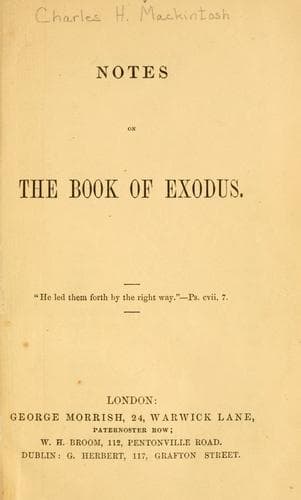
Notes on the book of ExodusMackintosh, Charles Henry
Religion
Notes on the book of Exodus
Mackintosh, Charles Henry
Bible. Exodus -- Commentaries
Nothing can be more interesting or instructive than the mode in which
Jehovah was pleased to reveal Himself to Moses, as presented in the
above quotation. He was about to furnish him with his commission to
lead forth His people out of Egypt, that they might be His
assembly--His dwelling-place, in the wilderness and in the land of
Canaan; and the place from which He speaks is a burning bush. Apt,
solemn, and beautiful symbol of Jehovah dwelling in the midst of His
elect and redeemed congregation! "Our God is a consuming fire," not to
consume _us_, but to consume all in us and about us which is contrary
to His holiness, and, as such, subversive of our true and permanent
happiness. "Thy testimonies are very sure; holiness becometh Thy
house, O Lord, forever."
There are various instances, both in the Old and New Testaments, in
which we find God displaying Himself as "a consuming fire." Look, for
example, at the case of Nadab and Abihu, in Leviticus x. This was a
deeply solemn occasion. God was dwelling in the midst of His people,
and He would keep them in a condition worthy of Himself. He could not
do otherwise. It would neither be for His glory nor for their profit
were He to tolerate aught in them inconsistent with the purity of His
presence. God's dwelling-place must be holy.
So, also, in Joshua vii. we have another striking proof, in the case
of Achan, that Jehovah could not possibly sanction, by His presence,
evil, in any shape or form, how covert soever that evil might be. He
was "a consuming fire," and as such He should act, in reference to any
attempt to defile that assembly in the midst of which He dwelt. To
seek to connect God's presence with evil unjudged is the very highest
character of wickedness.
Again, in Acts v, Ananias and Sapphira teach us the same solemn
lesson. God the Holy Ghost was dwelling in the midst of the Church,
not merely as an influence, but as a divine Person, in such a way as
that one could lie to Him. The Church was, and is still, His
dwelling-place; and He must rule and judge in the midst thereof. Men
may walk in company with deceit, covetousness, and hypocrisy; but God
cannot. If God is going to walk with us, we must judge our ways, or He
will judge them for us. (See also 1 Cor. xi. 29-32.)
In all these cases, and many more which might be adduced, we see the
force of that solemn word, "Holiness becometh Thy house, O Lord,
forever." The moral effect of this will ever be similar to that
produced in the case of Moses, as recorded in our chapter. "Draw not
nigh hither: put off thy shoes from off thy feet, for _the place
whereon thou standest is holy ground_." (Verse 5.) The place of God's
presence is holy, and can only be trodden with unshod feet. God,
dwelling in the midst of His people, imparts a character of holiness
to their assembly, which is the basis of every holy affection and
every holy activity. The character of the dwelling-place takes its
stamp from the character of the Occupant.
Public-domain text, read in full here on John Shaqi.
Reviews
Reviews
No reviews yet
Be the first to share your thoughts on this work.
Join the Discussion
Join the discussion
Sign in to leave a comment or review.
Sign InorCreate an account