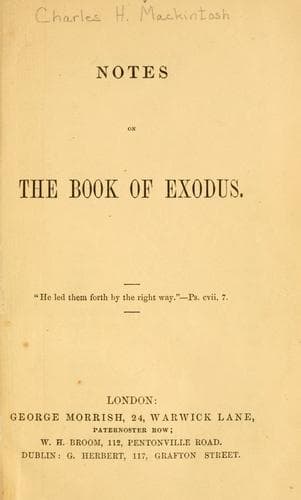
Notes on the book of ExodusMackintosh, Charles Henry
Religion
Notes on the book of Exodus
Mackintosh, Charles Henry
Bible. Exodus -- Commentaries
Happy is the man who ministers thus, whatever be the success or
reception of his ministry. For should his ministry fail to attract
attention, to command influence, or to produce apparent results, he
has his sweet retreat and his unfailing portion in Christ, of which
nothing can deprive him. Whereas, the man who is merely feeding upon
the fruits of his ministry, who delights in the gratification which it
affords, or the attention and interest which it commands, is like a
mere pipe, conveying water to others, and retaining only rust itself.
This is a most deplorable condition to be in; and yet is it the actual
condition of every servant who is more occupied with his work and its
results, than with the Master and His glory.
This is a matter which calls for the most rigid self-judgment. The
heart is deceitful, and the enemy is crafty; and hence there is great
need to hearken to the word of exhortation, "Be sober, be vigilant."
It is when the soul is awakened to a sense of the varied and manifold
dangers which beset the servant's path, that it is, in any measure,
able to understand the need there is for being much alone with God: it
is there one is secure and happy. It is when we begin, continue, and
end our work at the Master's feet, that our service will be of the
right kind.
From all that has been said, it must be evident to my reader that
every servant of Christ will find the air of "the backside of the
desert" most salutary. Horeb is really the starting-post for all whom
God sends forth to act for Him. It was at Horeb that Moses learnt to
put off his shoes and hide his face. Forty years before, he had gone
to work; but his movement was premature. It was amid the
flesh-subduing solitudes of the mount of God, and forth from the
burning bush, that the divine commission fell on the servant's ear,
"Come now, therefore, and I will send thee unto Pharaoh, that thou
mayest bring forth my people, the children of Israel, out of Egypt."
(Ver. 10.) Here was real authority. There is a vast difference between
God sending a man, and a man running unsent. But it is very manifest
that Moses was not ripe for service when first he set about acting. If
forty years of secret training were needful for him, how could he have
got on without it? Impossible! He had to be divinely educated and
divinely commissioned; and so must all who go forth upon a path of
service or testimony for Christ. O, that these holy lessons may be
deeply graven on all our hearts, that so our every work may wear upon
it the stamp of the Master's authority and the Master's approval.
Public-domain text, read in full here on John Shaqi.
Reviews
Reviews
No reviews yet
Be the first to share your thoughts on this work.
Join the Discussion
Join the discussion
Sign in to leave a comment or review.
Sign InorCreate an account