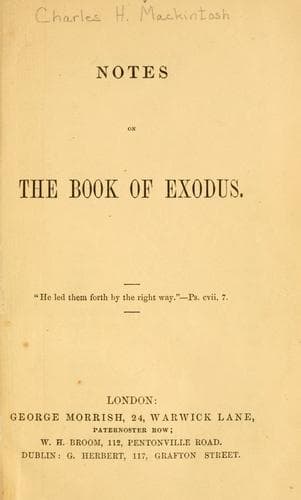
Notes on the book of ExodusMackintosh, Charles Henry
Religion
Notes on the book of Exodus
Mackintosh, Charles Henry
Bible. Exodus -- Commentaries
However, we have something further to learn at the foot of Mount
Horeb. The soul finds it seasonable to linger in this place. "It is
good to be here." The presence of God is ever a deeply practical
place; the heart is sure to be laid open there. The light that shines
in that holy place makes everything manifest; and this is what is so
much needed in the midst of the hollow pretension around us, and the
pride and self-complacency within.
We might be disposed to think that the very moment the divine
commission was given to Moses, his reply would be, Here am I, or,
Lord, what wilt Thou have me to do? But no; he had yet to be brought
to this. Doubtless, he was affected by the remembrance of his former
failure. If a man acts in anything without God, he is sure to be
discouraged, even when God is sending him. "And Moses said unto God,
'Who am I that I should go unto Pharaoh, and that I should bring forth
the children of Israel out of Egypt?'" (Ver. 11.) This is very unlike
the man who, forty years before, "supposed that his brethren would
have understood how that God by his hand would deliver them." Such is
man!--at one time too hasty; at another time too slow. Moses had
learnt a great deal since the day in which he smote the Egyptian. He
had grown in the knowledge of himself, and this produced diffidence
and timidity. But then he manifestly lacked confidence in God. If I am
merely looking at myself, I shall do "nothing;" but if I am looking at
Christ, "I can do all things." Thus, when diffidence and timidity led
Moses to say, "Who am I?" God's answer was, "Certainly _I_ will be
with thee." (Ver. 12.) This ought to have been sufficient. If God be
with me, it makes very little matter who I am, or what I am. When God
says, "I will send thee," and "I will be with thee," the servant is
amply furnished with divine authority and divine power; and he ought,
therefore, to be perfectly satisfied to go forth.
But Moses puts another question; for the human heart is full of
questions. "And Moses said unto God, 'Behold, when I come unto the
children of Israel and shall say unto them, The God of your fathers
hath sent me unto you; and they shall say to me, What is His name?
what shall I say unto them?'" It is marvelous to see how the human
heart reasons and questions, when unhesitating obedience is that which
is due to God; and still more marvelous is the grace that bears with
all the reasonings and answers all the questions. Each question seems
but to elicit some new feature of divine grace.
Public-domain text, read in full here on John Shaqi.
Reviews
Reviews
No reviews yet
Be the first to share your thoughts on this work.
Join the Discussion
Join the discussion
Sign in to leave a comment or review.
Sign InorCreate an account