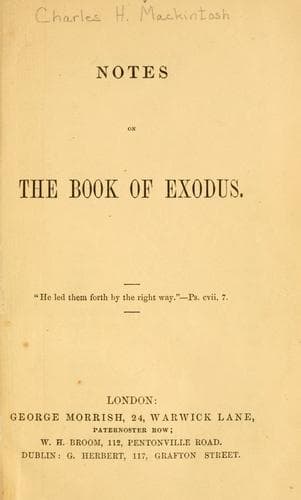
Notes on the book of ExodusMackintosh, Charles Henry
Religion
Notes on the book of Exodus
Mackintosh, Charles Henry
Bible. Exodus -- Commentaries
The knowledge of this truth ought to have delivered Moses from his
diffidence and inordinate timidity. When the Lord had so graciously
assured him that He would be with his mouth, it should have set his
mind at rest as to the question of eloquence. The Maker of man's mouth
could fill that mouth with the most commanding eloquence, if such were
needed. This, in the judgment of faith, is most simple; but, alas! the
poor doubting heart would place far more confidence in an eloquent
tongue than in the One who created it. This would seem most
unaccountable, did we not know the materials of which the natural
heart is composed. That heart cannot trust God; and hence it is that
even the people of God, when they suffer themselves to be in any
measure governed by nature, exhibit such a humiliating lack of
confidence in the living God.
Thus, in the scene before us, we find Moses still demurring. "And he
said, 'O my Lord, send, I pray Thee, by the hand of him whom Thou wilt
send.'" This was, in reality, casting from him the high honor of being
Jehovah's sole messenger to Egypt and to Israel.
It were needless to say that divinely-wrought humility is an
inestimable grace. To "be clothed with humility" is a divine precept;
and humility is unquestionably the most becoming dress in which a
worthless sinner can appear. But it cannot be called humility to
refuse to take the place which God assigns, or to tread the path which
His hand marks out for us. That it was not true humility in Moses is
obvious from the fact that "the anger of the Lord was kindled against
him." So far from its being humility, it had actually passed the limit
of mere weakness. So long as it wore the aspect of an excessive
timidity, however reprehensible, God's boundless grace bore with it,
and met it with renewed assurances; but when it assumed the character
of unbelief and slowness of heart, it drew down Jehovah's just
displeasure; and Moses, instead of being the sole, is made a joint,
instrument in the work of testimony and deliverance.
Nothing is more dishonoring to God, or more dangerous for us, than a
mock humility. When we refuse to occupy a position which the grace of
God assigns us, because of our not possessing certain virtues and
qualifications, this is not humility, inasmuch as if we could but
satisfy our own consciences in reference to such virtues and
qualifications, we should then deem ourselves entitled to assume the
position. If, for instance, Moses had possessed such a measure of
eloquence as he deemed needful, we may suppose he would have been
ready to go. Now the question is, How much eloquence would he have
needed to furnish him for his mission? The answer is, Without God, no
amount of human eloquence would have availed; but with God, the merest
stammerer would have proved an efficient minister.
Public-domain text, read in full here on John Shaqi.
Reviews
Reviews
No reviews yet
Be the first to share your thoughts on this work.
Join the Discussion
Join the discussion
Sign in to leave a comment or review.
Sign InorCreate an account