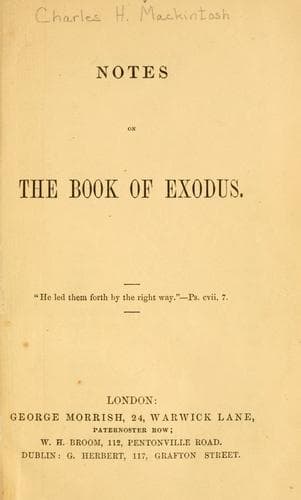
Notes on the book of ExodusMackintosh, Charles Henry
Religion
Notes on the book of Exodus
Mackintosh, Charles Henry
Bible. Exodus -- Commentaries
This is a great practical truth. Unbelief is not humility, but
thorough pride. It refuses to believe God because it does not find in
_self_ a reason for believing. This is the very height of presumption.
If, when God speaks, I refuse to believe, on the ground of something
in myself, I make Him a liar. (1 John v. 10.) When God declares His
love, and I refuse to believe because I do not deem myself a
sufficiently worthy object, I make Him a liar, and exhibit the
inherent pride of my heart. The bare supposition that I could ever be
worthy of aught save the lowest pit of hell, can only be regarded as
the most profound ignorance of my own condition and of God's
requirements. And the refusal to take the place which the redeeming
love of God assigns me, on the ground of the finished atonement of
Christ, is to make God a liar, and cast gross dishonor upon the
sacrifice of the cross. God's love flows forth spontaneously. It is
not drawn forth by my deserts, but by my misery. Nor is it a question
as to the place which I deserve, but which Christ deserves. Christ
took the sinner's place on the cross, that the sinner might take His
place in the glory. Christ got what the sinner deserved, that the
sinner might get what Christ deserves. Thus _self_ is totally set
aside, and this is true humility. No one can be truly humble until he
has reached heaven's side of the cross; but there he finds divine
life, divine righteousness, and divine favor. He is done with himself
forever, as regards any expectation of goodness or righteousness, and
he feeds upon the princely wealth of another. He is morally prepared
to join in that cry which shall echo through the spacious vault of
heaven, throughout the everlasting ages, "Not unto us, O Lord, not
unto us, but unto Thy name give glory." (Psalm cxv. 1.)
It would ill become us to dwell upon the mistakes or infirmities of so
honored a servant as Moses, of whom we read that he "was verily
faithful in all his house, as a servant, for a testimony of those
things which were to be spoken after." (Heb. iii. 5.) But, though we
should not dwell upon them in a spirit of self-complacency, as if we
would have acted differently in his circumstances, we should
nevertheless learn from such things those holy and seasonable lessons
which they are manifestly designed to teach. We should learn to judge
ourselves and to place more implicit confidence in God,--to set self
aside, that He might act in us, through us, and for us. This is the
true secret of power.
Public-domain text, read in full here on John Shaqi.
Reviews
Reviews
No reviews yet
Be the first to share your thoughts on this work.
Join the Discussion
Join the discussion
Sign in to leave a comment or review.
Sign InorCreate an account