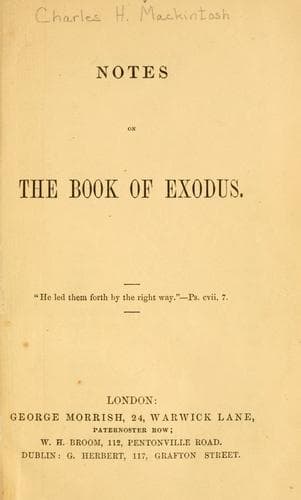
Notes on the book of ExodusMackintosh, Charles Henry
Religion
Notes on the book of Exodus
Mackintosh, Charles Henry
Bible. Exodus -- Commentaries
The wildest mistake which a man can possibly fall into is to act
without taking God into his account. Sooner or later, the thought of
God will force itself upon him, and then comes the awful crash of all
his schemes and calculations. At best, everything that is undertaken
independently of God, can last but for the present time. It cannot, by
any possibility, stretch itself into eternity. All that is merely
human, however solid, however brilliant, or however attractive, must
fall into the cold grasp of death, and moulder in the dark, silent
tomb. The clod of the valley must cover man's highest excellencies and
brightest glories; mortality is engraved upon his brow, and all his
schemes are evanescent. On the contrary, that which is connected with,
and based upon, God, shall endure forever. "His name shall endure
forever, and His memorial to all generations."
What a sad mistake, therefore, for a feeble mortal to set himself up
against the eternal God,--to "rush upon the thick bosses of the shield
of the Almighty"! As well might the monarch of Egypt have sought to
stem, with his puny hand, the ocean's tide, as to prevent the increase
of those who were the subjects of Jehovah's everlasting purpose.
Hence, although "they did set over them taskmasters to afflict them
with their burdens," yet, "the more they afflicted them, the more they
multiplied and grew." Thus it must ever be. "He that sitteth in the
heavens shall laugh; the Lord shall have them in derision." (Ps. ii.
4.) Eternal confusion shall be inscribed upon all the opposition of
men and devils. This gives sweet rest to the heart in the midst of a
scene where all is apparently so contrary to God and so contrary to
faith. Were it not for the settled assurance that "the wrath of man
shall praise" the Lord, the spirit would often be cast down while
contemplating the circumstances and influences which surround one in
the world. Thank God, "we look not at the things which are seen, but
at the things which are not seen: for the things which are seen are
temporal; but the things which are not seen are eternal." (2 Cor. iv.
18.) In the power of this, we may well say, "_Rest_ in the Lord, and
_wait patiently for Him_: fret not thyself because of him who
prospereth in his way, because of the man who bringeth wicked devices
to pass." (Ps. xxxvii. 7.) How fully might the truth of this be seen
in the case of both the oppressed and the oppressor, as set before us
in our chapter! Had Israel "looked at the things that are seen," what
were they? Pharaoh's wrath, stern taskmasters, afflictive burdens,
rigorous service, hard bondage, mortar and brick. But, then, "the
things which are not seen," what were they? God's eternal purpose, His
unfailing promise, the approaching dawn of a day of salvation, the
"burning lamp" of Jehovah's deliverance. Wondrous contrast! Faith
alone could enter into it. Naught save that precious principle could
enable any poor, oppressed Israelite to look from out the smoking
Public-domain text, read in full here on John Shaqi.
Reviews
Reviews
No reviews yet
Be the first to share your thoughts on this work.
Join the Discussion
Join the discussion
Sign in to leave a comment or review.
Sign InorCreate an account