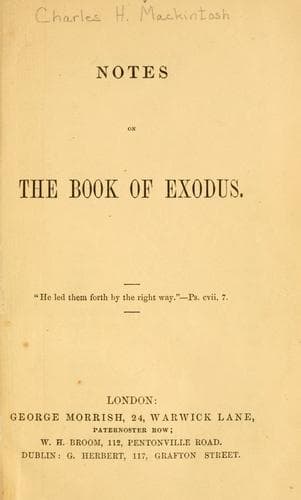
Notes on the book of ExodusMackintosh, Charles Henry
Religion
Notes on the book of Exodus
Mackintosh, Charles Henry
Bible. Exodus -- Commentaries
furnace of Egypt, to the green fields and vine-clad mountains of the
land of Canaan. Faith alone could recognize in those oppressed slaves,
toiling in the brick-kilns of Egypt, the heirs of salvation, and the
objects of Heaven's peculiar interest and favor.
Thus it was then, and thus it is now. "We walk by faith, not by
sight." (2 Cor. v. 7.) "It doth not yet appear what we shall be." (1
John iii. 2.) We are "here in the body pent," "absent from the Lord."
As to fact, we are in Egypt, yet, in spirit, we are in the heavenly
Canaan. Faith brings the heart into the power of divine and unseen
things, and thus enables it to mount above everything down here, in
this place "where death and darkness reign." O, for that simple
childlike faith that sits beside the pure and eternal fountain of
truth, there to drink those deep and refreshing draughts which lift up
the fainting spirit and impart energy to the new man, in its upward
and onward course!
The closing verses of this section of our book present an edifying
lesson in the conduct of those God-fearing women, Shiprah and Puah.
They would not carry out the king's cruel scheme, but braved his
wrath, and hence God made them houses. "Them that honor Me I will
honor, and they that despise Me shall be lightly esteemed." (1 Sam.
ii. 30.) May we ever remember this, and act for God, under all
circumstances!
CHAPTER II. 1-10.
This section of our book abounds in the weightiest principles of
divine truth--principles which range themselves under the three
following heads, namely, the power of Satan, the power of God, and the
power of faith.
In the last verse of the previous chapter, we read, "And Pharaoh
charged all his people, saying, 'Every son that is born ye shall cast
into the river.'" This was Satan's power. The river was the place of
death; and, by death, the enemy sought to frustrate the purpose of
God. It has ever been thus. The serpent has at all times watched with
malignant eye those instruments which God was about to use for His own
gracious ends. Look at the case of Abel, in Genesis iv. What was that
but the serpent watching God's vessel and seeking to put it out of the
way by death? Look at the case of Joseph, in Genesis xxxvii. There you
have the enemy seeking to put the man of God's purpose in the place of
death. Look at the case of "the seed royal," in 2 Chronicles xxii; the
act of Herod, in Matthew ii; the death of Christ, in Matthew xxvii. In
all these cases, you find the enemy seeking, by death, to interrupt
the current of divine action.
Public-domain text, read in full here on John Shaqi.
Reviews
Reviews
No reviews yet
Be the first to share your thoughts on this work.
Join the Discussion
Join the discussion
Sign in to leave a comment or review.
Sign InorCreate an account