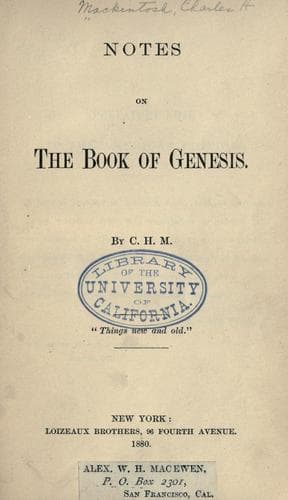
Notes on the Book of GenesisMackintosh, Charles Henry
Religion
Notes on the Book of Genesis
Mackintosh, Charles Henry
Bible. Genesis -- Commentaries
Now, it is when thus recalled to God's high and holy standard, that one
is really led to see the sad evil of one's fallen condition. What a
fearful amount of moral evil had gathered round Jacob's family,
unjudged by him, until his soul was roused by the call to "go up to
Bethel." Shechem was not the place in which to detect all this evil.
The atmosphere of that place was too much impregnated with impure
elements to admit of the soul's discerning, with any degree of
clearness and precision, the true character of evil. But the moment the
call to Bethel fell on Jacob's ear, "Then Jacob said unto his
household, and to all that were with him, Put away the strange gods
that are among you, and be clean and change your garments, and let us
arise and go up to Bethel; and I will make thee an altar unto God, who
answered me in the day of my distress, and was with me in the way which
I went." The very mention of "the house of God" struck a chord in the
soul of the patriarch; it carried him, in the twinkling of an eye, over
the history of twenty eventful years. It was at Bethel he had learnt
what God was, and not at Shechem; hence he must get back to Bethel
again, and erect an altar upon a totally different base, and under a
totally different name, from his altar at Shechem. This latter was
connected with a mass of uncleanness and idolatry.
Jacob could speak of "El-elohe-Israel," while surrounded by a quantity
of things utterly incompatible with the holiness of the house of God.
It is important to be clear in reference to this point. Nothing can
keep the soul in a path of consistent, intelligent separation from evil
save the sense of what "the house of God" is, and what becomes that
house. If I merely look at God, in reference to myself, I shall not
have a clear, full, divine sense of all that flows out of a due
recognition of God's relation to his house. Some there are who deem it
a matter of no importance how they are mixed up with impure materials
in the worship of God, provided they themselves are true and upright in
heart. In other words, they think they can worship God at Shechem; and
that an altar named "El-elohe-Israel" is just as elevated, just as much
according to God, as an altar named "El Bethel." This is evidently a
mistake. The spiritually-minded reader will at once detect the vast
moral difference between Jacob's condition at Shechem and his condition
at Bethel; and the same difference is observable between the two
altars. Our ideas in reference to the worship of God must, of
necessity, be affected by our spiritual condition; and the worship
which we present will be low and contracted, or elevated and
comprehensive, just in proportion as we enter into the apprehension of
his character and relationship.
Public-domain text, read in full here on John Shaqi.
Reviews
Reviews
No reviews yet
Be the first to share your thoughts on this work.
Elsewhere in the archive
Join the Discussion
Join the discussion
Sign in to leave a comment or review.
Sign InorCreate an account