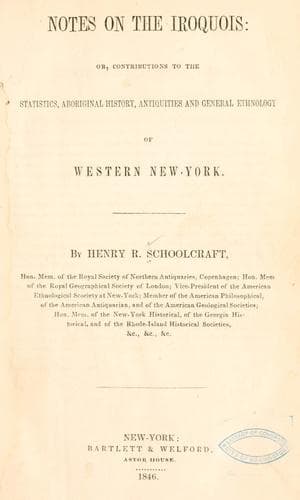
Notes on the Iroquois: or, Contributions to the Statistics, Aboriginal History, Antiquities and General Ethnology of Western New-YorkSchoolcraft, Henry Rowe
History
Notes on the Iroquois: or, Contributions to the Statistics, Aboriginal History, Antiquities and General Ethnology of Western New-York
Schoolcraft, Henry Rowe
Indians of North America -- New York (State); Iroquois Indians
Whence then, it may be asked, is the origin of the word Buffalo, since
it is not found in the Indian term? Tradition denotes that the range of
this animal once extended to the banks of the great lakes. There was
a current opinion among the early travellers along the shores of Lake
Erie, that the bison had been seen and killed on this creek. Whether
the impression arose from, or was traceable, in part or wholly, to a
deception of certain hunters in bringing in “other flesh,” under the
denomination of Buffalo meat, as has been said, it would be difficult
to determine. From whatever cause, it is certain that the stream
acquired the popular name it now bears at an early day, whilst the
aboriginal name was neglected.
The dotted lines are designed to show the probable figure and
extent of the work, from the accounts of the Indians. That it was a
circular work, appears to be denoted by the only parts of the wall
yet remaining, which are drawn in black. The site itself was elevated
moderately above the plain. There is no reason to suppose that this
elevation of the surface was artificial. The relative position of
the creek is denoted by G. H marks the position of a stone, which
is connected with the history of their domestic arts, before the
discovery of the country. It was not practicable to obtain accurate
admeasurements of distances; the design being merely to present a
pencil sketch.
V. ANCIENT STATE OF INDIAN ART.
To denote the state of art among the aboriginal race, it is necessary
closely to examine such monuments of it, as exist. The word “monument”
is used to denote any remains of art. Such are their relics in the form
of worked shells and amulets, pottery, carved implements and utensils
of stone, and other antiquarian remains found in their mounds, graves,
fortifications, and other places of ancient occupancy in our latitudes.
Of architectural ruins in stone, which constitute so striking a portion
of aboriginal antiquities, in central and South America, particularly
in the ruins of their temples and teocalli, (the only form of such
architecture indeed, which survives,) we have no remains north of
the latitude of the mouth of the Mississippi, unless they shall be
disclosed in some of the large mounds yet unopened, or in portions of
the country north of such a line, which yet remains unexplored, west of
the extreme sources of the Red river and the Rio Del Norte.
Public-domain text, read in full here on John Shaqi.
Reviews
Reviews
No reviews yet
Be the first to share your thoughts on this work.
Elsewhere in the archive
Join the Discussion
Join the discussion
Sign in to leave a comment or review.
Sign InorCreate an account