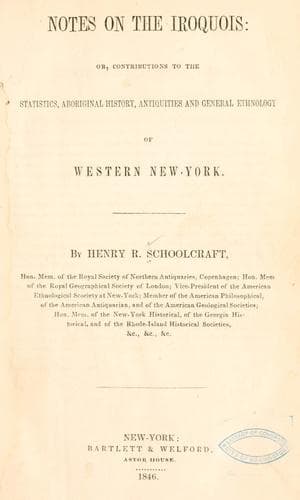
Notes on the Iroquois: or, Contributions to the Statistics, Aboriginal History, Antiquities and General Ethnology of Western New-YorkSchoolcraft, Henry Rowe
History
Notes on the Iroquois: or, Contributions to the Statistics, Aboriginal History, Antiquities and General Ethnology of Western New-York
Schoolcraft, Henry Rowe
Indians of North America -- New York (State); Iroquois Indians
From this inquiry, we may peremptorily exclude, all articles and
remains of metal (not gold, silver or native copper) and all sculpture
and inscriptions (not picture writing) which have been found and
commented on, with an air of wonder, in various places, but which are
one and all, undoubtedly of European, or to give the greatest scope
to conjecture, of trans-atlantic origin. Such are, to begin with the
highest object, the Grave creek inscription in apparently Celtiberic
characters, the stone with a rude inscription in Roman letters and
Arabic figures found in Onondaga county, and now deposited in the
Albany Academy; the amulets of coarse enamel colored pastes and glass,
of the imperfect fabric of the 15th and 16th centuries, found in Indian
graves; or old village and fort sites, together with the flattened
gun barrels, broken locks, artists’ tools and other articles of
iron, brass, or semi-vitrified earthenware, which are found over so
considerable an extent of country in western New-York. The latter are
undoubtedly, evidences of either earlier, or more systematic attempts
to settle, if not to found colonies, amongst the RED RACE from
abroad, than we are yet prepared fully to comprehend. But there need be
no question as to the general era and character of art to which they
belong; they are too clearly European in every instance to admit of
scruple.
The introduction of the fabrics of European art, among the tribes of
this continent, had the inevitable and speedy effect to destroy the
prior Indian arts. It is astonishing to find how soon the aborigines
of our latitudes, lost the art of making culinary vessels of clay; of
carving amulets and pipes out of steatites and other fissile mineral
bodies; of perforating, dissecting and forming sea shells into the
various shapes of wampum, gorgets, pendants, necklaces, belt and pouch
ornaments, and other ornamental fabrics. They no sooner obtained the
light brass, copper, iron, and tin kettle, than they laid aside the
more clumsy and frail AKEEK, or clay pot; their women relieved
from the labor of selecting and tempering the clays, and forming it
into pots and dishes, were advanced one step in the art of housewifery,
and took the first lesson in European civilization.
Public-domain text, read in full here on John Shaqi.
Reviews
Reviews
No reviews yet
Be the first to share your thoughts on this work.
Elsewhere in the archive
Join the Discussion
Join the discussion
Sign in to leave a comment or review.
Sign InorCreate an account