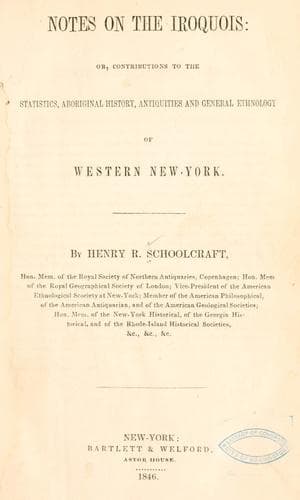
Notes on the Iroquois: or, Contributions to the Statistics, Aboriginal History, Antiquities and General Ethnology of Western New-YorkSchoolcraft, Henry Rowe
History
Notes on the Iroquois: or, Contributions to the Statistics, Aboriginal History, Antiquities and General Ethnology of Western New-York
Schoolcraft, Henry Rowe
Indians of North America -- New York (State); Iroquois Indians
The maker of arrow and javelin heads, for this was a distinct art,
was superceded by the superior efficacy of fire arms; and his red
descendant at this day, as well as the gleaner of antiquities, is
alike at a loss to find, where the ancient artist in chert and
hornstone procured his materials of so suitable a quality and
fracture, and how he obtained the skill to chip and form them into
such delicate and appropriate patterns. The small and slender axe of
iron, with a steel edge, and pipe-head, at once took the place of the
crescent-shaped stone tomahawk, which had alone been appropriated to
war; while the larger half-axe, so called, supplanted the clumsy stone
AGAKWUT before employed rather as a gouge to detach coal
in the process of felling trees by fire, than an axe proper. By the
application of the common lathe and turning chisel, those species of
thick sea shells, which the natives had, with so much labor, converted
into seawan and wampum, were manufactured with such superior skill,
expedition and cheapness, (although this is an article which the
trader always held comparatively high) that the old Indian art of
the _wampum-maker_, sunk, like that of the _arrow-maker_, never to be
revived. But of all the exchanges made between civilized and savage
life, the gift of the steel-trap, in replacing the Indian trap of wood,
was the most eagerly sought, and highly prized by the hunter, although
it hastened the period of the destruction of the whole class of furred
animals, and thus in effect, brought to a speedy close the Indian
dominion.
Pottery was an art known universally among all the tribes from
Patagonia to the Arctic ocean, but was practised with very different
degrees of skill. The northern tribes who bordered on the great lakes,
and thence reached down to the Atlantic, made a rude article, which
just answered the simple purposes of the culinary art. The clay, or
argillaceous material used for it, was such as is common to diluvial
and tertiary soils. It was tempered with silex, in the form of pounded
quartz, or often quartz and field-spar, as it exists in granite, in
quite coarse particles. This mixture prevented shrinkage and cracks in
drying, and enabled the mass to withstand the application of heat—an
art which has resulted, and would very soon result, in any given case,
from experience. There were no legs to the Indian _akeek_, or pot. It
was designed to be used, to use a chemical phrase, as a sand-bath.
Being set on the ashes, a fire was built around it. It might also admit
of suspension, by a bark cord tied below the lip, which flared out
well, and thus could be attached to the ordinary Indian cooking-tackle,
namely; a long-legged tripod, tied at the top with bark.
Public-domain text, read in full here on John Shaqi.
Reviews
Reviews
No reviews yet
Be the first to share your thoughts on this work.
Elsewhere in the archive
Join the Discussion
Join the discussion
Sign in to leave a comment or review.
Sign InorCreate an account