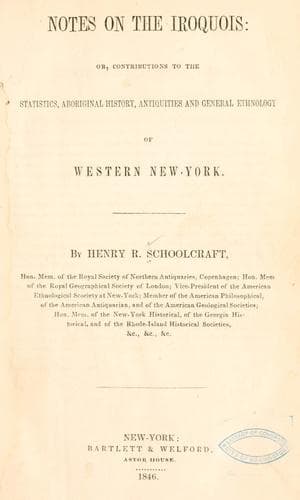
Notes on the Iroquois: or, Contributions to the Statistics, Aboriginal History, Antiquities and General Ethnology of Western New-YorkSchoolcraft, Henry Rowe
History
Notes on the Iroquois: or, Contributions to the Statistics, Aboriginal History, Antiquities and General Ethnology of Western New-York
Schoolcraft, Henry Rowe
Indians of North America -- New York (State); Iroquois Indians
There is no evidence in the structure of any of this species of
pottery, at least, in these latitudes, that it had been raised or
formed on a potter’s wheel. The fact that prepared clay placed on a
revolving horizontal circle, would rise, by the centrifugal force, if
resisted by the hand, or a potter’s stick or former, was not known to
these tribes; although it is admitted to be one of the oldest arts in
the world. Some skill was consequently required to form the mass and
shape the vessel, without machinery. It was essential to its utility,
and to prevent unequal shrinkage in drying, that the body should be
of uniform thickness; and this art was also, if we may judge from
fragments, and one or two entire vessels examined, very well attained.
It is believed that this art, in this quarter, was in the hands of
females; but every female or mistress of a lodge, was not adequate
to it. It must have been the business of a class of persons in each
village, who were professed potters. Tradition says that it was the
practice to mingle some blood in wetting and tempering the clay.
It was impossible that this art, so rude and laborious, and so
ill-suited to perform its offices when done, could survive and continue
to be practised for any length of time after the tribes had been made
acquainted with the products of the European potteries, rude as these
were comparatively speaking, in the fifteenth and sixteenth centuries.
Architecture, as it existed in the north and west, was confined, we
may suppose, to earthen structures, crowned with wood, in the shape
of beams and posts. And it is only as it exhibited a knowledge of
geometry, in the combination of squares and circles, to constitute a
work of defence, that it is deserving of notice. The knowledge of the
pyramid and its durability, is one of the most ancient geometrical
discoveries in the world, and it is quite clear, in viewing the mounds
and teocalli of North America, that the aborigines possessed, or had
not forgotten it. In most of the works of defence, in the western
country, the circular pyramid, or mound of earth of various sizes,
formed a striking feature; whilst in relation to the mounds used for
religious ceremonies, as we must suppose the larger mounds to have
been, its completeness of plan and exact truncation, parallel to the
plain or basis, denotes the prevalence among them, of this ancient
architectural idea. We detect also, in a survey of the old works, the
square, the parallelogram, the circle, and the ellipsis. And these
figures were variously employed in the arrangement of masses of earth,
to produce a rampart and a moat.
The domestic economy required implements to perform the arts which we
express by the words sewing and weaving.
Public-domain text, read in full here on John Shaqi.
Reviews
Reviews
No reviews yet
Be the first to share your thoughts on this work.
Elsewhere in the archive
Join the Discussion
Join the discussion
Sign in to leave a comment or review.
Sign InorCreate an account