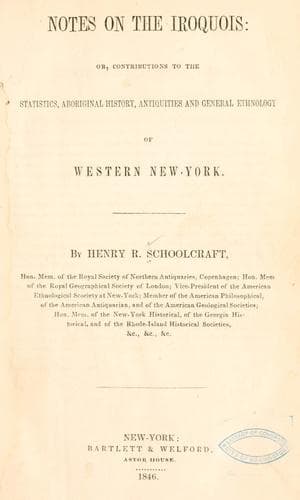
Notes on the Iroquois: or, Contributions to the Statistics, Aboriginal History, Antiquities and General Ethnology of Western New-YorkSchoolcraft, Henry Rowe
History
Notes on the Iroquois: or, Contributions to the Statistics, Aboriginal History, Antiquities and General Ethnology of Western New-York
Schoolcraft, Henry Rowe
Indians of North America -- New York (State); Iroquois Indians
The awl and needle were made from various species of animal bones of
the land and water. The larger awl used to perforate bark, in sewing
together the sheathing of the northern canoe, made from the rind of
the betula, was squared and brought to a tapering point. A very close
grain and compact species of bone was employed for the fine lodge awl
used for sewing dressed skins for garments. After this skin had been
perforated, a thread of deer’s sinew was drawn through, from the eye of
a slender bone needle. There was, besides this, a species of shuttle
of bone, which was passed backwards and forwards, in introducing the
bark woof of mats and bags; two kinds of articles, the work of which
was commonly made from the scirpus læustris or larger bulrush. It was
only necessary to exhibit the square and round awl, and gross and
fine needle of steel, to supercede these primitive and rude modes of
_seamstress-work_ and _weaving_.
In an examination of Indian antiquarian articles, taken from the graves
and mounds, there is some glimmering of the art of design. There is no
other branch of art to which we can refer the numerous class of carved
ornaments and amulets, or their skill in symbolical or representative
drawing, evinced in their picture writing.
Amulets and neck, ear and head ornaments, constituted a very ancient
and very important department in the arcanum of the Indian wardrobe.
They were not only a part of the personal gear and decorations which
our old British writers sometimes denote “braveries,” but they were
connected with his superstitions, and were a part of the external
system of his religion. The aboriginal man, who had never laid aside
his oriental notions of necromancy, and believed firmly in witchcraft,
wore them as charms. They were among the most cherished and valued
articles he could possibly possess. They were sought with great
avidity, at high prices, and, after having served their office of
warding off evil, while he lived, they were deposited in his grave,
at death. Bones, shells, carved stones, gems, claws and hoofs of
animals, feathers of carnivorous birds, and above all the skin of the
serpent, were cherished with the utmost care, and regarded with the
most superstitious veneration. To be decked with suitable amulets was
to him to be invested with a charmed life. They added to his feeling
of security and satisfaction in his daily avocations, and gave him new
courage in war.
Public-domain text, read in full here on John Shaqi.
Reviews
Reviews
No reviews yet
Be the first to share your thoughts on this work.
Elsewhere in the archive
Join the Discussion
Join the discussion
Sign in to leave a comment or review.
Sign InorCreate an account